Pearson+ LogoPearson+ Logo
Ch.5 Nuclear Chemistry
Timberlake - Chemistry: An Introduction to General, Organic, and Biological Chemistry 13th Edition
Timberlake13th EditionChemistry: An Introduction to General, Organic, and Biological ChemistryISBN: 9780134421353Not the one you use?Change textbook
Chapter 5, Problem 28b

Suppose a person absorbed 50 mrad of alpha radiation. What would be the equivalent dose in millisieverts?

Verified step by step guidance
1
Step 1: Understand the relationship between absorbed dose (in rad) and equivalent dose (in sieverts). The equivalent dose is calculated using the formula: H=D×Q, where H is the equivalent dose in sieverts, D is the absorbed dose in grays, and Q is the radiation weighting factor.
Step 2: Convert the absorbed dose from millirads (mrad) to grays (Gy). Recall that 1 rad = 0.01 Gy, and 1 mrad = 0.00001 Gy. Multiply the given absorbed dose (50 mrad) by 0.00001 to convert it to grays.
Step 3: Identify the radiation weighting factor (Q) for alpha radiation. Alpha particles have a weighting factor of 20 because they are highly ionizing.
Step 4: Multiply the absorbed dose in grays by the radiation weighting factor to calculate the equivalent dose in sieverts. Use the formula: H=D×Q.
Step 5: Convert the equivalent dose from sieverts to millisieverts (mSv). Recall that 1 sievert = 1000 millisieverts. Multiply the result in sieverts by 1000 to express the equivalent dose in millisieverts.

Verified video answer for a similar problem:

This video solution was recommended by our tutors as helpful for the problem above.
Video duration:
2m
Was this helpful?

Key Concepts

Here are the essential concepts you must grasp in order to answer the question correctly.

Radiation Dose

Radiation dose refers to the amount of energy deposited by ionizing radiation in a given mass of tissue. It is typically measured in grays (Gy) or rads, where 1 rad equals 0.01 Gy. Understanding radiation dose is crucial for assessing potential biological effects and risks associated with exposure.
Recommended video:
Guided course
02:06
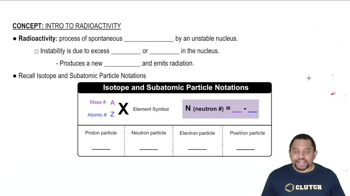
Types of Radiation Concept 1

Equivalent Dose

Equivalent dose is a measure that accounts for the biological effect of different types of radiation on human tissue. It is expressed in sieverts (Sv) or millisieverts (mSv) and is calculated by multiplying the absorbed dose by a radiation weighting factor, which varies depending on the type of radiation (e.g., alpha, beta, gamma).
Recommended video:
Guided course
01:43
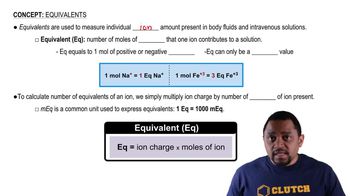
Equivalents Concept 1

Radiation Weighting Factor

The radiation weighting factor is a numerical value that reflects the relative biological effectiveness of different types of radiation. For alpha particles, this factor is typically set at 20, meaning that alpha radiation is considered 20 times more effective at causing biological damage than gamma or beta radiation. This factor is essential for converting absorbed dose to equivalent dose.
Recommended video:
Guided course
02:06
Types of Radiation Concept 1