Pearson+ LogoPearson+ Logo
Ch.5 Nuclear Chemistry
Timberlake - Chemistry: An Introduction to General, Organic, and Biological Chemistry 13th Edition
Timberlake13th EditionChemistry: An Introduction to General, Organic, and Biological ChemistryISBN: 9780134421353Not the one you use?Change textbook
Chapter 5, Problem 34b

Fluorine-18, which has a half-life of 110 min, is used in PET scans.
b. If 100. mg of fluorine-18 is shipped at 8:00 a.m., how many milligrams of the radioisotope are still active when the sample arrives at the radiology laboratory at 1:30 p.m.?

Verified step by step guidance
1
Determine the total time elapsed between 8:00 a.m. and 1:30 p.m. Subtract the starting time from the ending time. Convert the time into minutes for consistency. (1:30 p.m. is 13:30 in 24-hour format, so the elapsed time is 13:30 - 8:00 = 5 hours and 30 minutes, which equals 330 minutes.)
Calculate the number of half-lives that have passed. Use the formula: \( \text{Number of half-lives} = \frac{\text{Total time elapsed}}{\text{Half-life}} \). Here, the half-life of fluorine-18 is 110 minutes, so substitute the values: \( \text{Number of half-lives} = \frac{330}{110} \).
Use the radioactive decay formula to determine the remaining amount of fluorine-18. The formula is: \( A = A_0 \times (\frac{1}{2})^n \), where \( A \) is the remaining amount, \( A_0 \) is the initial amount, and \( n \) is the number of half-lives. Substitute \( A_0 = 100. \, \text{mg} \) and the calculated value of \( n \).
Simplify the expression \( (\frac{1}{2})^n \) to find the fraction of the original sample that remains after the elapsed time.
Multiply the initial amount \( A_0 \) by the fraction obtained in the previous step to calculate the remaining amount of fluorine-18 in milligrams.

Verified video answer for a similar problem:

This video solution was recommended by our tutors as helpful for the problem above.
Video duration:
1m
Was this helpful?

Key Concepts

Here are the essential concepts you must grasp in order to answer the question correctly.

Half-Life

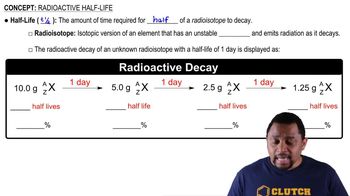
Half-life is the time required for half of a radioactive substance to decay. In the case of Fluorine-18, which has a half-life of 110 minutes, this means that after 110 minutes, only 50 mg of the original 100 mg would remain. Understanding half-life is crucial for calculating the remaining quantity of a radioactive isotope over time.
Recommended video:
Guided course
02:09
Radioactive Half-Life Concept 1

Radioactive Decay

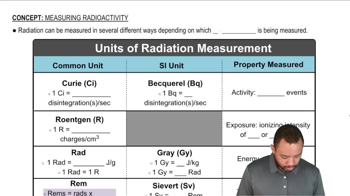
Radioactive decay is the process by which an unstable atomic nucleus loses energy by emitting radiation. This decay occurs at a predictable rate, characterized by the half-life. For Fluorine-18, this decay is important to determine how much of the isotope remains active after a certain period, which is essential for its application in medical imaging.
Recommended video:
Guided course
02:52
Measuring Radioactivity Concept 1

Exponential Decay Formula

The exponential decay formula is used to calculate the remaining quantity of a radioactive substance over time. It is expressed as N(t) = N0 * (1/2)^(t/T), where N(t) is the remaining quantity, N0 is the initial quantity, t is the elapsed time, and T is the half-life. This formula allows for precise calculations of how much Fluorine-18 remains active after the time interval from shipment to arrival.
Recommended video:
Guided course
06:46
Beta Decay Example 2