Pearson+ LogoPearson+ Logo
Ch.5 Nuclear Chemistry
Timberlake - Chemistry: An Introduction to General, Organic, and Biological Chemistry 13th Edition
Timberlake13th EditionChemistry: An Introduction to General, Organic, and Biological ChemistryISBN: 9780134421353Not the one you use?Change textbook
Chapter 5, Problem 30c

For each of the following, indicate if the number of half-lives elapsed is:
1. one half-life
2. two half-lives
3. three half-lives
c. a sample of Au-198 with a half-life of 2.7 days after 5.4 days

Verified step by step guidance
1
Determine the half-life of the isotope, which is given as 2.7 days for Au-198.
Calculate the total time elapsed, which is provided as 5.4 days.
Divide the total time elapsed (5.4 days) by the half-life (2.7 days) to determine the number of half-lives that have passed. Use the formula: tt1/2, where t is the elapsed time and t1/2 is the half-life.
Simplify the division to find the number of half-lives elapsed. Ensure the units (days) cancel out during the calculation.
Compare the result to the options provided (1 half-life, 2 half-lives, 3 half-lives) to determine the correct answer.

Verified video answer for a similar problem:

This video solution was recommended by our tutors as helpful for the problem above.
Video duration:
1m
Was this helpful?

Key Concepts

Here are the essential concepts you must grasp in order to answer the question correctly.

Half-Life

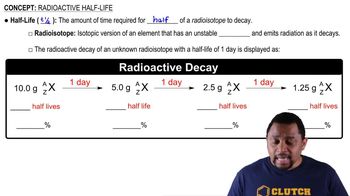
Half-life is the time required for half of a sample of a radioactive substance to decay. It is a constant property of the substance and is crucial for understanding the rate of decay. For example, if a substance has a half-life of 2.7 days, after one half-life, 50% of the original amount remains, and after two half-lives, 25% remains.
Recommended video:
Guided course
02:09
Radioactive Half-Life Concept 1

Radioactive Decay

Radioactive decay is the process by which an unstable atomic nucleus loses energy by emitting radiation. This process occurs at a predictable rate characterized by the half-life. Understanding this concept is essential for calculating how much of a radioactive isotope remains after a certain period, which is key to answering the question.
Recommended video:
Guided course
02:52
Measuring Radioactivity Concept 1

Elapsed Time and Half-Lives

Elapsed time in the context of half-lives refers to the total time that has passed since the start of the decay process. By dividing the elapsed time by the half-life duration, one can determine how many half-lives have occurred. In the case of Au-198 with a half-life of 2.7 days, after 5.4 days, two half-lives have elapsed, indicating that 25% of the original sample remains.
Recommended video:
Guided course
02:09
Radioactive Half-Life Concept 1