Pearson+ LogoPearson+ Logo
Ch.6 Ionic and Molecular Compounds
Timberlake - Chemistry: An Introduction to General, Organic, and Biological Chemistry 13th Edition
Timberlake13th EditionChemistry: An Introduction to General, Organic, and Biological ChemistryISBN: 9780134421353Not the one you use?Change textbook
Chapter 6, Problem 97g

Consider the following Lewis symbols for elements X and Y:
Lewis dot symbols for elements X and Y, illustrating their valence electrons for ion formation analysis.
g. Is the compound in part f ionic or molecular?

Verified step by step guidance
1
Step 1: Analyze the Lewis symbols provided in the image. The element 'D' has one dot, indicating it has one valence electron, while element 'E' has six dots, indicating it has six valence electrons.
Step 2: Determine the type of bond that would form between these elements. Element 'D' is likely to donate its single electron, while element 'E' needs two electrons to complete its octet.
Step 3: Consider the electronegativity difference between the two elements. If 'D' is a metal and 'E' is a nonmetal, the bond is likely ionic. If both are nonmetals, the bond is likely covalent (molecular).
Step 4: Recall that ionic compounds form when electrons are transferred from one atom to another, resulting in charged ions. Molecular compounds form when atoms share electrons to achieve stability.
Step 5: Based on the Lewis symbols and the bonding behavior, decide whether the compound is ionic or molecular. Use the periodic table to confirm the classification of elements 'D' and 'E' as metals or nonmetals.

Verified video answer for a similar problem:

This video solution was recommended by our tutors as helpful for the problem above.
Video duration:
1m
Was this helpful?

Key Concepts

Here are the essential concepts you must grasp in order to answer the question correctly.

Lewis Symbols

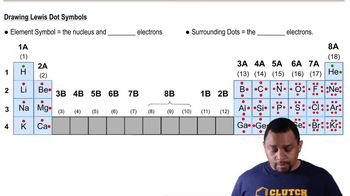
Lewis symbols represent the valence electrons of an atom using dots around the element's symbol. Each dot corresponds to a valence electron, which is crucial for understanding how atoms bond. In the context of the question, analyzing the Lewis symbols for elements D and E helps determine their bonding behavior, whether they form covalent or ionic compounds.
Recommended video:
Guided course
01:27
Lewis Dot Symbols (Simplified) Concept 2

Ionic vs. Molecular Compounds

Ionic compounds are formed through the transfer of electrons from one atom to another, resulting in charged ions that attract each other. In contrast, molecular compounds are formed when atoms share electrons through covalent bonds. Understanding the difference between these types of compounds is essential for determining the nature of the compound formed by elements D and E based on their Lewis symbols.
Recommended video:
Guided course
02:11
Naming Ionic Compounds

Covalent Bonding

Covalent bonding occurs when two atoms share one or more pairs of electrons, typically between nonmetals. This type of bonding is indicated by the presence of shared electron pairs in Lewis structures. Analyzing the Lewis symbols for elements D and E will reveal whether they are likely to form covalent bonds, which would suggest a molecular compound rather than an ionic one.
Recommended video:
Guided course
01:04
Covalent Bonds Example 1