Pearson+ LogoPearson+ Logo
Ch.6 Ionic and Molecular Compounds
Timberlake - Chemistry: An Introduction to General, Organic, and Biological Chemistry 13th Edition
Timberlake13th EditionChemistry: An Introduction to General, Organic, and Biological ChemistryISBN: 9780134421353Not the one you use?Change textbook
Chapter 6, Problem 128a

Draw the Lewis structure for each of the following:
a. H3COCH3 (the atoms are in the order C O C)

Verified step by step guidance
1
Step 1: Count the total number of valence electrons. Hydrogen (H) has 1 valence electron, carbon (C) has 4 valence electrons, and oxygen (O) has 6 valence electrons. Add these together for all the atoms in H₃COCH₃ to determine the total number of valence electrons available for the Lewis structure.
Step 2: Arrange the atoms in the correct skeletal structure. The problem specifies that the atoms are in the order C-O-C, with the hydrogens attached to the carbons. Place the central oxygen atom between the two carbon atoms, and attach three hydrogens to each carbon atom.
Step 3: Place single bonds between the atoms to connect them. Draw single bonds between the two carbons and the oxygen, and between each carbon and its three hydrogens. Each single bond represents 2 electrons.
Step 4: Distribute the remaining valence electrons as lone pairs around the oxygen atom to satisfy its octet rule. Ensure that the oxygen atom has 8 electrons around it, including the bonding electrons.
Step 5: Verify that all atoms satisfy the octet rule (or duet rule for hydrogen) and that the total number of electrons used matches the total valence electrons calculated in Step 1. Adjust if necessary to ensure the structure is correct.

Verified video answer for a similar problem:

This video solution was recommended by our tutors as helpful for the problem above.
Video duration:
7m
Was this helpful?

Key Concepts

Here are the essential concepts you must grasp in order to answer the question correctly.

Lewis Structure

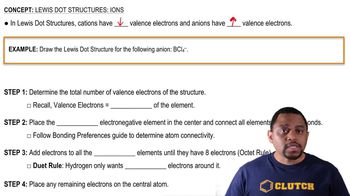
A Lewis structure is a diagram that represents the bonding between atoms in a molecule and the lone pairs of electrons that may exist. It uses dots to represent valence electrons and lines to represent bonds between atoms. Understanding how to draw Lewis structures is essential for visualizing molecular geometry and predicting the behavior of molecules in chemical reactions.
Recommended video:
Guided course
03:11
Lewis Dot Structures: Ions (Simplified) Concept 1

Valence Electrons

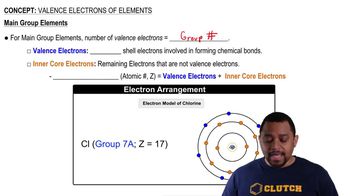
Valence electrons are the electrons in the outermost shell of an atom that are involved in forming bonds with other atoms. The number of valence electrons determines how an atom can bond with others, influencing the molecule's structure and reactivity. For example, carbon has four valence electrons, which allows it to form four bonds, while oxygen has six, allowing it to form two bonds.
Recommended video:
Guided course
01:55
Valence Electrons of Elements (Simplified) Concept 1

Molecular Geometry

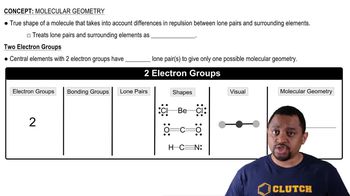
Molecular geometry refers to the three-dimensional arrangement of atoms within a molecule. It is influenced by the number of bonds and lone pairs around the central atom, which can affect the molecule's physical and chemical properties. Understanding molecular geometry is crucial for predicting how molecules will interact with each other and their environment.
Recommended video:
Guided course
01:30
Molecular Geometry (Simplified) Concept 1