Pearson+ LogoPearson+ Logo
Ch.6 Ionic and Molecular Compounds
Timberlake - Chemistry: An Introduction to General, Organic, and Biological Chemistry 13th Edition
Timberlake13th EditionChemistry: An Introduction to General, Organic, and Biological ChemistryISBN: 9780134421353Not the one you use?Change textbook
Chapter 6, Problem 133a

Show the dipole arrow for each of the following bonds:
a. Si―Cl

Verified step by step guidance
1
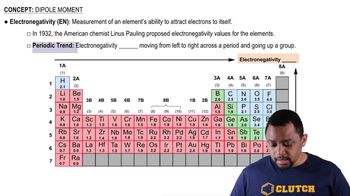
Determine the electronegativity of each atom in the bond. Silicon (Si) has an electronegativity of approximately 1.90, and chlorine (Cl) has an electronegativity of approximately 3.16.
Calculate the difference in electronegativity between the two atoms: ΔEN = |EN(Cl) - EN(Si)|. This difference will help determine the polarity of the bond.
Since chlorine (Cl) has a higher electronegativity than silicon (Si), the shared electrons in the bond will be pulled closer to the chlorine atom, creating a partial negative charge (δ⁻) on Cl and a partial positive charge (δ⁺) on Si.
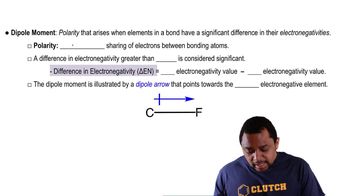
Draw the dipole arrow pointing from the less electronegative atom (Si) to the more electronegative atom (Cl). The arrow should have a cross at the tail (near Si) to indicate the positive end, and the arrowhead should point toward Cl to indicate the negative end.
Label the bond with the partial charges: δ⁺ near Si and δ⁻ near Cl, to clearly show the direction of the dipole moment.

Verified video answer for a similar problem:

This video solution was recommended by our tutors as helpful for the problem above.
Video duration:
2m
Was this helpful?

Key Concepts

Here are the essential concepts you must grasp in order to answer the question correctly.

Dipole Moment

A dipole moment is a measure of the separation of positive and negative charges in a molecule, indicating the polarity of a bond. It arises when there is a difference in electronegativity between the two atoms involved in the bond, leading to an uneven distribution of electron density. The dipole is represented by an arrow pointing from the positive end to the negative end, with the length of the arrow indicating the strength of the dipole.
Recommended video:
Guided course
01:25
Dipole Moment (Simplified) Concept 2

Electronegativity

Electronegativity is the tendency of an atom to attract electrons in a chemical bond. It is a key factor in determining the polarity of a bond; the greater the difference in electronegativity between two bonded atoms, the more polar the bond will be. In the case of the Si-Cl bond, silicon has a lower electronegativity compared to chlorine, resulting in a polar bond with a dipole moment.
Recommended video:
Guided course
01:51
Dipole Moment (Simplified) Concept 1

Bond Polarity

Bond polarity refers to the distribution of electrical charge over the atoms joined by the bond. A bond can be classified as nonpolar if the electron density is evenly distributed, or polar if there is an unequal sharing of electrons. In the Si-Cl bond, the significant difference in electronegativity leads to a polar bond, which can be represented by a dipole arrow pointing towards the more electronegative chlorine atom.
Recommended video:
Guided course
01:34
Molecular Polarity (Simplified) Concept 1