Pearson+ LogoPearson+ Logo
Ch.7 Chemical Quantities and Reactions
Timberlake - Chemistry: An Introduction to General, Organic, and Biological Chemistry 13th Edition
Timberlake13th EditionChemistry: An Introduction to General, Organic, and Biological ChemistryISBN: 9780134421353Not the one you use?Change textbook
Chapter 7, Problem 85b

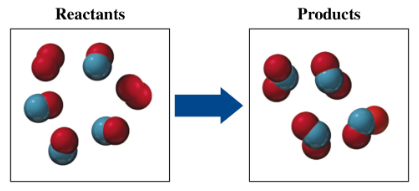
If red spheres represent oxygen atoms, blue spheres represent nitrogen atoms, and all the molecules are gases,

b. write a balanced equation for the reaction.

Verified step by step guidance
1
Step 1: Analyze the image provided. The reactants consist of green spheres representing chlorine atoms (Cl₂ molecules) and magenta spheres representing fluorine atoms (F₂ molecules). The products consist of molecules where each green sphere is bonded to a magenta sphere, forming chlorine monofluoride (ClF).
Step 2: Identify the chemical reaction taking place. The reactants are chlorine gas (Cl₂) and fluorine gas (F₂), and the products are chlorine monofluoride (ClF).
Step 3: Write the unbalanced chemical equation for the reaction: Cl₂ + F₂ → ClF.
Step 4: Balance the equation by ensuring the number of atoms of each element is the same on both sides of the equation. Since each Cl₂ molecule reacts with each F₂ molecule to produce two ClF molecules, the balanced equation is: Cl₂ + F₂ → 2ClF.
Step 5: Verify the balanced equation by counting the atoms on both sides. On the reactants side, there are 2 chlorine atoms and 2 fluorine atoms. On the products side, there are 2 chlorine atoms and 2 fluorine atoms, confirming the equation is balanced.

Verified video answer for a similar problem:

This video solution was recommended by our tutors as helpful for the problem above.
Video duration:
1m
Was this helpful?

Key Concepts

Here are the essential concepts you must grasp in order to answer the question correctly.

Chemical Reaction

A chemical reaction involves the transformation of reactants into products through the breaking and forming of chemical bonds. In this context, the red spheres represent oxygen atoms, and the blue spheres represent nitrogen atoms, indicating that the reaction involves these elements. Understanding the nature of the reactants and products is crucial for writing a balanced chemical equation.
Recommended video:
Guided course
00:58
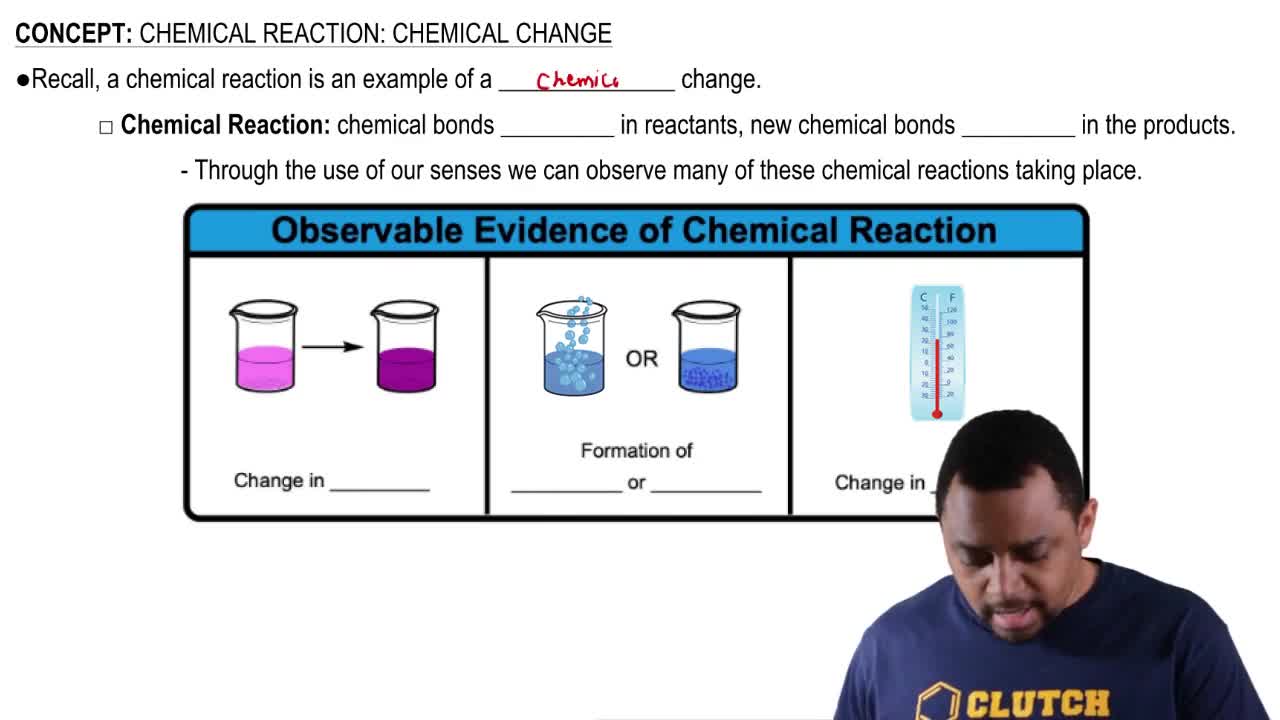
Chemical Reaction: Chemical Change Concept 1

Balanced Chemical Equation

A balanced chemical equation represents a chemical reaction with equal numbers of each type of atom on both sides of the equation. This ensures the law of conservation of mass is upheld, meaning matter is neither created nor destroyed. To write a balanced equation, one must account for the number of each type of atom present in the reactants and products, adjusting coefficients as necessary.
Recommended video:
Guided course
01:32
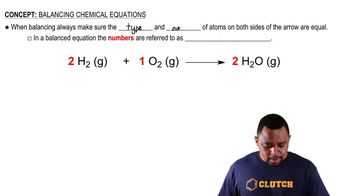
Balancing Chemical Equations (Simplified) Concept 1

Molecular Representation

Molecular representation uses visual models, such as colored spheres, to depict the structure and composition of molecules. In the provided image, different colors represent different atoms, helping to visualize how they combine in a reaction. This representation aids in understanding the molecular interactions and the stoichiometry involved in balancing the chemical equation.
Recommended video:
Guided course
2:08
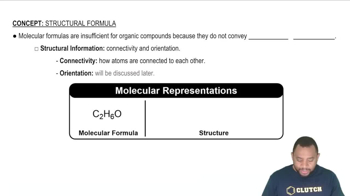
Molecular Representations Concept 1