Pearson+ LogoPearson+ Logo
Ch.7 Chemical Quantities and Reactions
Timberlake - Chemistry: An Introduction to General, Organic, and Biological Chemistry 13th Edition
Timberlake13th EditionChemistry: An Introduction to General, Organic, and Biological ChemistryISBN: 9780134421353Not the one you use?Change textbook
Chapter 7, Problem 83b

Balance each of the following by adding coefficients, and identify the type of reaction for each:
b.

Verified step by step guidance
1
Step 1: Analyze the image. The reactants consist of a molecule with two red spheres, two blue spheres, and three purple spheres. The products consist of a molecule with two blue spheres, a single red sphere, and a single purple sphere.
Step 2: Write the unbalanced chemical equation based on the image. Represent the reactants and products using their respective colors or chemical symbols. For example, the reactants could be written as AB2 + C3, and the products as B2 + A + C.
Step 3: Balance the equation by ensuring the number of atoms of each element is the same on both sides of the equation. Adjust the coefficients in front of each compound to achieve this balance.
Step 4: Identify the type of reaction. Based on the image, this appears to be a decomposition reaction, where a single compound breaks down into simpler substances.
Step 5: Verify the balanced equation by counting the atoms of each element on both sides to ensure they match. Double-check the reaction type classification.

Verified video answer for a similar problem:

This video solution was recommended by our tutors as helpful for the problem above.
Video duration:
2m
Was this helpful?

Key Concepts

Here are the essential concepts you must grasp in order to answer the question correctly.

Chemical Reaction Types

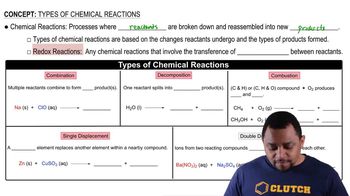
Chemical reactions can be classified into several types, including synthesis, decomposition, single replacement, and double replacement. Each type has distinct characteristics based on how reactants interact and transform into products. Understanding these categories helps in predicting the products of a reaction and balancing chemical equations.
Recommended video:
Guided course
04:07
Types of Chemical Reactions Concept 1

Balancing Chemical Equations

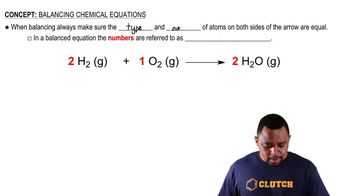
Balancing chemical equations involves ensuring that the number of atoms for each element is the same on both sides of the equation. This is achieved by adjusting coefficients in front of the chemical formulas. Balancing is crucial for obeying the law of conservation of mass, which states that matter cannot be created or destroyed in a chemical reaction.
Recommended video:
Guided course
01:32
Balancing Chemical Equations (Simplified) Concept 1

Molecular Representation

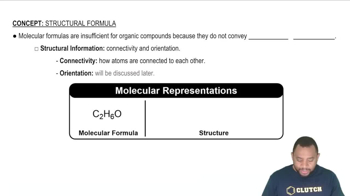
Molecular representation uses symbols and diagrams to depict the structure and composition of molecules involved in a chemical reaction. In the provided image, colored spheres represent different atoms or molecules, illustrating how they combine or separate during the reaction. This visual aid is essential for understanding the reactants and products in a chemical equation.
Recommended video:
Guided course
2:08
Molecular Representations Concept 1