
Pearson+ LogoPearson+ Logo
Ch.8 Gases
Timberlake - Chemistry: An Introduction to General, Organic, and Biological Chemistry 13th Edition
Timberlake13th EditionChemistry: An Introduction to General, Organic, and Biological ChemistryISBN: 9780134421353Not the one you use?Change textbook
Chapter 8, Problem 67c

A balloon is filled with helium gas with a partial pressure of 1.00 atm and neon gas with a partial pressure of 0.50 atm. For each of the following changes (a to e) of the initial balloon, select the diagram (A, B, or C) that shows the final volume of the balloon:
<IMAGE>
c. All of the neon gas is removed (T and P do not change).

Verified step by step guidance
1
Step 1: Begin by understanding the concept of partial pressure. The total pressure of a gas mixture is the sum of the partial pressures of each individual gas. In this case, the initial total pressure is the sum of helium's partial pressure (1.00 atm) and neon's partial pressure (0.50 atm), which equals 1.50 atm.
Step 2: Recognize that removing all the neon gas will reduce the total pressure of the gas mixture. Since the partial pressure of neon is 0.50 atm, removing it leaves only the helium gas with a partial pressure of 1.00 atm.
Step 3: Recall Boyle's Law, which states that for a given amount of gas at constant temperature, the pressure and volume are inversely proportional: \( P_1 V_1 = P_2 V_2 \). Here, the temperature and pressure are constant, so the volume of the balloon will adjust to reflect the change in pressure.
Step 4: Analyze the diagrams provided (A, B, or C). The final volume of the balloon will correspond to the new pressure of 1.00 atm, which is lower than the initial total pressure of 1.50 atm. This means the balloon's volume will decrease.
Step 5: Select the diagram that visually represents the reduced volume of the balloon after the neon gas is removed. Compare the diagrams to identify the one that matches the expected decrease in volume.

Verified video answer for a similar problem:

This video solution was recommended by our tutors as helpful for the problem above.
Video duration:
2m
Was this helpful?

Key Concepts

Here are the essential concepts you must grasp in order to answer the question correctly.

Partial Pressure

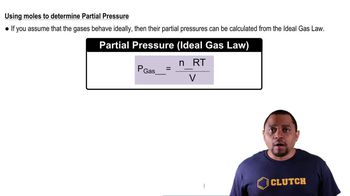
Partial pressure refers to the pressure exerted by a single type of gas in a mixture of gases. In this scenario, the balloon contains helium and neon gases, each contributing to the total pressure. The partial pressures of 1.00 atm for helium and 0.50 atm for neon indicate how much each gas contributes to the overall pressure within the balloon.
Recommended video:
Guided course
00:48
Dalton's Law: Partial Pressure (Simplified) Concept 2

Gas Laws

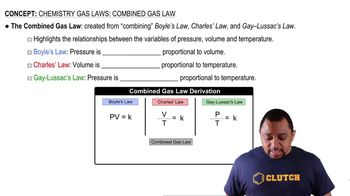
Gas laws describe the behavior of gases under various conditions of temperature and pressure. In this case, the relevant gas law is Boyle's Law, which states that the volume of a gas is inversely proportional to its pressure when temperature is constant. Removing neon gas will decrease the total pressure, leading to an increase in the balloon's volume.
Recommended video:
Guided course
01:43
Chemistry Gas Laws: Combined Gas Law

Volume Change in Gases

The volume of a gas can change in response to alterations in pressure and the amount of gas present. When neon gas is removed from the balloon while keeping temperature and pressure constant, the remaining helium gas will occupy a larger volume due to the decrease in total gas pressure, demonstrating the principle of gas expansion.
Recommended video:
Guided course
01:53
Physical & Chemical Changes