Pearson+ LogoPearson+ Logo
Ch.9 Solutions
Timberlake - Chemistry: An Introduction to General, Organic, and Biological Chemistry 13th Edition
Timberlake13th EditionChemistry: An Introduction to General, Organic, and Biological ChemistryISBN: 9780134421353Not the one you use?Change textbook
Chapter 9, Problem 17

An intravenous saline solution contains 154 mEq/L each of Na+ and Cl. How many moles each of Na+ and Cl are in 1.00 L of the saline solution?

Verified step by step guidance
1
Understand the relationship between milliequivalents (mEq) and moles. Milliequivalents measure the amount of charge contributed by ions in solution. For monovalent ions like Na⁺ and Cl⁻, 1 mEq corresponds to 1 millimole (mmol). Therefore, 154 mEq/L is equivalent to 154 mmol/L for each ion.
Convert millimoles to moles. Since 1 mmol = 10⁻³ moles, multiply the given concentration (154 mmol/L) by 10⁻³ to express it in moles per liter (mol/L).
Determine the number of moles in 1.00 L of solution. Multiply the molar concentration (mol/L) of each ion by the volume of the solution (1.00 L). This gives the total moles of Na⁺ and Cl⁻ in the solution.
Recognize that the problem specifies equal concentrations of Na⁺ and Cl⁻ in the solution. Therefore, the calculated moles for Na⁺ will be the same as the calculated moles for Cl⁻.
Summarize the process: Convert mEq/L to mol/L, then multiply by the volume of the solution to find the moles of each ion. Ensure units are consistent throughout the calculation.

Verified video answer for a similar problem:

This video solution was recommended by our tutors as helpful for the problem above.
Video duration:
11m
Was this helpful?

Key Concepts

Here are the essential concepts you must grasp in order to answer the question correctly.

Molarity and Moles

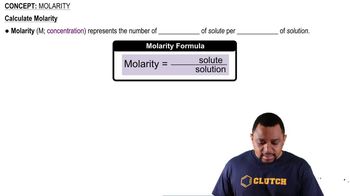
Molarity is a measure of concentration defined as the number of moles of solute per liter of solution. To find the number of moles in a solution, you can multiply the molarity by the volume of the solution in liters. In this case, knowing the concentration in mEq/L allows for conversion to moles using the equivalent weight of the ions.
Recommended video:

Equivalents and Milliequivalents

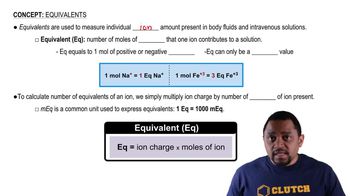
An equivalent (Eq) is a unit that measures the reactive capacity of an ion, often used in chemistry to express the amount of a substance that reacts with or replaces one mole of hydrogen ions. Milliequivalents (mEq) are one-thousandth of an equivalent. In this question, 154 mEq/L indicates the concentration of Na⁺ and Cl⁻ ions, which can be converted to moles based on their valence.
Recommended video:
Guided course
01:43
Equivalents Concept 1

Ion Composition in Saline Solutions

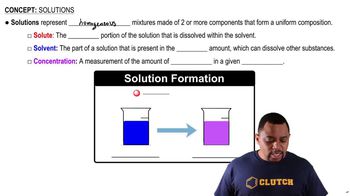
Saline solutions typically consist of sodium (Na⁺) and chloride (Cl⁻) ions, which are essential for maintaining osmotic balance in the body. The concentration of these ions in a saline solution is crucial for medical applications, and understanding their molar relationships helps in calculating the total moles present in a given volume, such as 1.00 L in this case.
Recommended video: