Indicate whether aqueous solutions of each of the following solutes contain only ions, only molecules, or mostly molecules and a few ions: c. fructose, C6H12O6, a nonelectrolyte
Ch.9 Solutions
Timberlake13th EditionChemistry: An Introduction to General, Organic, and Biological ChemistryISBN: 9780134421353Not the one you use?Change textbook
Chapter 9, Problem 15d
Calculate the number of equivalents in each of the following:
d. 3 moles of CO32–
Verified step by step guidance1
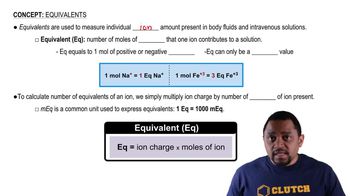
Understand the concept of equivalents: In chemistry, an equivalent is the amount of a substance that reacts with or supplies one mole of hydrogen ions (H⁺) or electrons in a reaction. For ions, the number of equivalents is determined by multiplying the number of moles by the absolute value of the ion's charge.
Identify the charge of the ion: The carbonate ion (CO₃²⁻) has a charge of -2. This means each mole of CO₃²⁻ can provide 2 equivalents.
Write the formula to calculate the number of equivalents: The number of equivalents is given by the equation:
Substitute the given values into the formula: Here, the number of moles is 3, and the absolute value of the charge is 2. Substitute these values into the formula:
Perform the multiplication to determine the total number of equivalents. This will give you the final result.

Verified video answer for a similar problem:
This video solution was recommended by our tutors as helpful for the problem above.
Video duration:
1mWas this helpful?
Key Concepts
Here are the essential concepts you must grasp in order to answer the question correctly.
Moles
A mole is a unit in chemistry that represents a specific quantity of particles, typically atoms or molecules. One mole is defined as 6.022 x 10²³ entities, known as Avogadro's number. Understanding moles is essential for converting between the mass of a substance and the number of particles it contains, which is crucial for stoichiometric calculations.
Recommended video:
Guided course
Mole Concept
Equivalents
In chemistry, an equivalent is a measure that relates to the reactive capacity of a substance. It is defined as the amount of a substance that can react with or supply one mole of hydrogen ions (H⁺) in a reaction. The concept of equivalents is particularly important in acid-base chemistry and redox reactions, where it helps quantify the amount of reactants needed.
Recommended video:
Guided course
Equivalents Concept 1
Charge of Ions
The charge of an ion indicates its electrical state, which is crucial for understanding its reactivity and interactions in chemical reactions. For example, CO₃²⁻ (carbonate ion) has a charge of -2, meaning it can react with two moles of H⁺ ions. This charge influences how many equivalents of the ion are present in a given number of moles, impacting calculations in stoichiometry.
Recommended video:
Guided course
Polyatomic Ions
Related Practice
Textbook Question
1731
views
Textbook Question
Classify the solute represented in each of the following equations as a strong, weak, or nonelectrolyte:
a.
1821
views
Textbook Question
Classify the solute represented in each of the following equations as a strong, weak, or nonelectrolyte:
b. NH3(g) + H2O(l) ⇌ NH4+(aq) + OH–(aq)
1833
views
Textbook Question
Calculate the number of equivalents in each of the following:
d. 2 moles of Fe3+
1372
views
Textbook Question
An intravenous saline solution contains 154 mEq/L each of Na+ and Cl–. How many moles each of Na+ and Cl– are in 1.00 L of the saline solution?
1423
views
Textbook Question
An intravenous solution contains 40. mEq/L of Cl– and 15 mEq/L of HPO42–. If Na+ is the only cation in the solution, what is the Na+ concentration, in milliequivalents per liter?
1838
views