Pearson+ LogoPearson+ Logo
Ch.9 Solutions
Timberlake - Chemistry: An Introduction to General, Organic, and Biological Chemistry 13th Edition
Timberlake13th EditionChemistry: An Introduction to General, Organic, and Biological ChemistryISBN: 9780134421353Not the one you use?Change textbook
Chapter 9, Problem 19

An intravenous solution contains 40. mEq/L of Cl and 15 mEq/L of HPO42–. If Na+ is the only cation in the solution, what is the Na+ concentration, in milliequivalents per liter?

Verified step by step guidance
1
Understand the problem: The solution contains two anions, Cl⁻ and HPO₄²⁻, with concentrations given in milliequivalents per liter (mEq/L). Since Na⁺ is the only cation, its concentration must balance the total charge contributed by the anions to maintain electrical neutrality.
Calculate the total negative charge contributed by the anions. Add the milliequivalents per liter of Cl⁻ and HPO₄²⁻, taking into account their charges. For Cl⁻, the charge is -1, and for HPO₄²⁻, the charge is -2. However, the mEq/L values already account for these charges, so simply sum the given values: 40 mEq/L (Cl⁻) + 15 mEq/L (HPO₄²⁻).
Recognize that the total positive charge contributed by Na⁺ must equal the total negative charge from the anions. Therefore, the Na⁺ concentration in mEq/L will be equal to the total negative charge calculated in the previous step.
Express the Na⁺ concentration in milliequivalents per liter (mEq/L), as this is the unit requested in the problem. Since the solution is electrically neutral, the Na⁺ concentration will directly match the total negative charge.
Verify the solution by ensuring that the total positive charge (from Na⁺) equals the total negative charge (from Cl⁻ and HPO₄²⁻). This confirms that the solution is electrically neutral, as required.

Verified video answer for a similar problem:

This video solution was recommended by our tutors as helpful for the problem above.
Video duration:
2m
Was this helpful?

Key Concepts

Here are the essential concepts you must grasp in order to answer the question correctly.

Milliequivalents (mEq)

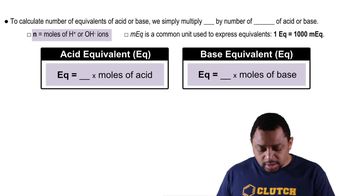
Milliequivalents (mEq) is a unit of measure used in chemistry and medicine to express the amount of a substance based on its chemical activity. It accounts for the valence of ions, allowing for the comparison of different ions in terms of their ability to react. For example, 1 mEq of Na⁺ is equivalent to 1 mEq of Cl⁻ because both have a valence of 1.
Recommended video:
Guided course
00:46
Acid-Base Equivalents Concept 2

Electroneutrality Principle

The electroneutrality principle states that in a solution, the total positive charge must equal the total negative charge. This principle is crucial for calculating ion concentrations in solutions, as it ensures that the solution remains electrically neutral. In this case, the concentration of Na⁺ must balance the concentrations of Cl⁻ and HPO₄²⁻ to maintain electroneutrality.

Ion Concentration Calculation

Calculating ion concentration involves determining the amount of each ion present in a solution, often expressed in milliequivalents per liter (mEq/L). In this scenario, to find the Na⁺ concentration, one must sum the negative charges from Cl⁻ and HPO₄²⁻ and set this equal to the Na⁺ concentration, as it is the only cation present. This calculation is essential for understanding the overall ionic balance in intravenous solutions.
Recommended video:
Guided course
00:52
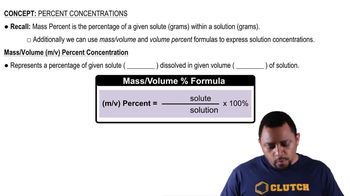
Percent Concentrations Concept 1