
Pearson+ LogoPearson+ Logo
Ch.9 Solutions
Timberlake - Chemistry: An Introduction to General, Organic, and Biological Chemistry 13th Edition
Timberlake13th EditionChemistry: An Introduction to General, Organic, and Biological ChemistryISBN: 9780134421353Not the one you use?Change textbook
Chapter 9, Problem 87a

Potassium nitrate has a solubility of 32 g of KNO3 in 100. g of H2O at 20 °C. Determine if each of the following forms an unsaturated or saturated solution at 20 °C:
a. adding 32 g of KNO3 to 200. g of H2O

Verified step by step guidance
1
Step 1: Understand the problem. The solubility of potassium nitrate (KNO₃) is given as 32 g in 100 g of water at 20 °C. This means that at this temperature, 32 g of KNO₃ can dissolve completely in 100 g of water to form a saturated solution. Any additional KNO₃ beyond this amount would remain undissolved, making the solution saturated.
Step 2: Analyze the given scenario. In this case, 32 g of KNO₃ is being added to 200 g of water. Since the amount of water is doubled (200 g instead of 100 g), the solubility limit also doubles. Therefore, calculate the new solubility limit for 200 g of water.
Step 3: Use proportional reasoning to determine the solubility limit. If 32 g of KNO₃ dissolves in 100 g of water, then in 200 g of water, the solubility limit is: \( 32 \text{ g} \times \frac{200 \text{ g H₂O}}{100 \text{ g H₂O}} \).
Step 4: Compare the amount of KNO₃ added (32 g) to the solubility limit calculated in Step 3. If the amount of KNO₃ added is less than or equal to the solubility limit, the solution is unsaturated. If it exceeds the solubility limit, the solution is saturated.
Step 5: Conclude whether the solution is unsaturated or saturated based on the comparison in Step 4. Remember, an unsaturated solution means all the solute dissolves, while a saturated solution means some solute remains undissolved.

Verified video answer for a similar problem:

This video solution was recommended by our tutors as helpful for the problem above.
Video duration:
4m
Was this helpful?

Key Concepts

Here are the essential concepts you must grasp in order to answer the question correctly.

Solubility

Solubility is the maximum amount of a solute that can dissolve in a specific amount of solvent at a given temperature. For potassium nitrate (KNO₃), its solubility at 20 °C is 32 g per 100 g of water. This means that if you exceed this amount in a given volume of water, the solution will become saturated, and any additional solute will not dissolve.
Recommended video:
Guided course
00:28
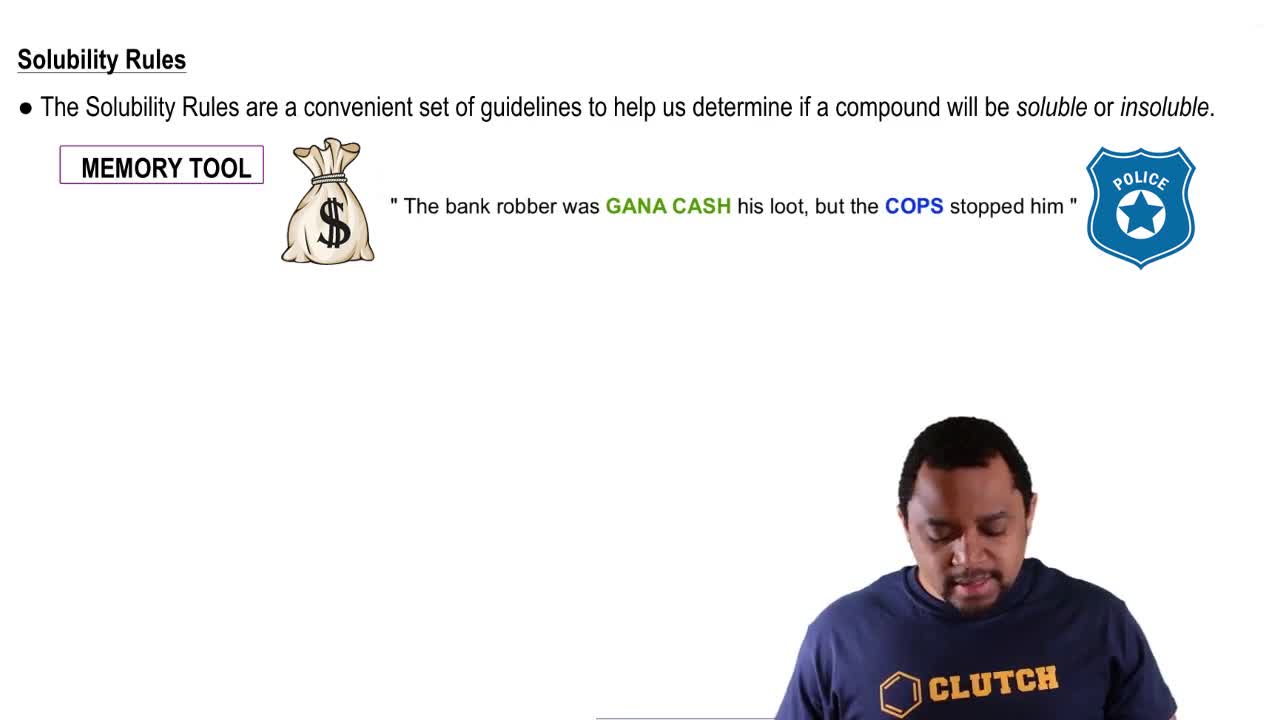
Solubility Rules

Saturated Solution

A saturated solution is one in which the maximum amount of solute has been dissolved in the solvent at a specific temperature. In this case, if 32 g of KNO₃ is added to 100 g of water, the solution is saturated. However, if more solvent is added, such as 200 g of water, the solubility limit changes, allowing for more solute to dissolve before reaching saturation.
Recommended video:

Unsaturated Solution

An unsaturated solution is one that contains less solute than the maximum amount that can be dissolved at a given temperature. In the scenario of adding 32 g of KNO₃ to 200 g of water, the solution is unsaturated because the increased amount of solvent allows for more solute to dissolve without reaching the saturation point, which would be 64 g of KNO₃ in this case.
Recommended video: