
Pearson+ LogoPearson+ Logo
Ch.9 Solutions
Timberlake - Chemistry: An Introduction to General, Organic, and Biological Chemistry 13th Edition
Timberlake13th EditionChemistry: An Introduction to General, Organic, and Biological ChemistryISBN: 9780134421353Not the one you use?Change textbook
Chapter 9, Problem 96

An 80-proof brandy is a 40.% (v/v) ethanol solution. The "proof" is twice the percent concentration of alcohol in the beverage. How many milliliters of alcohol are present in 750 mL of brandy?

Verified step by step guidance
1
Understand the relationship between proof and percent concentration: Proof is defined as twice the percent concentration of alcohol. For an 80-proof brandy, the percent concentration of ethanol is 40.0% (v/v). This means 40.0 mL of ethanol is present in every 100 mL of brandy.
Identify the total volume of the brandy given in the problem: The total volume of the brandy is 750 mL.
Set up the calculation to determine the volume of ethanol: Use the percent concentration (v/v) as a conversion factor. Multiply the total volume of the brandy by the percent concentration expressed as a decimal (40.0% = 0.400). The formula is: Volume of ethanol=Total volume of brandy × 0.400
Substitute the given values into the formula: Replace the total volume of brandy with 750 mL. The equation becomes: Volume of ethanol=750 × 0.400
Perform the multiplication to find the volume of ethanol in milliliters. Ensure the final answer is reported with the correct number of significant figures based on the given data (3 significant figures for 750 mL and 40.0%).

Verified video answer for a similar problem:

This video solution was recommended by our tutors as helpful for the problem above.
Video duration:
1m
Was this helpful?

Key Concepts

Here are the essential concepts you must grasp in order to answer the question correctly.

Proof and Alcohol Concentration

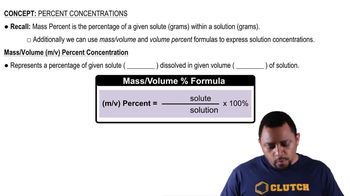
Proof is a measure of the strength of an alcoholic beverage, defined as twice the percentage of alcohol by volume (ABV). For example, an 80-proof beverage contains 40% ethanol, meaning that in every 100 mL of the beverage, there are 40 mL of pure alcohol. Understanding this relationship is crucial for calculating the amount of alcohol in a given volume of the beverage.
Recommended video:
Guided course
00:52
Percent Concentrations Concept 1

Volume and Concentration Calculations

To determine the amount of alcohol in a solution, one can use the formula: Volume of alcohol = Total volume × (Alcohol concentration/100). In this case, knowing the total volume of the brandy (750 mL) and its alcohol concentration (40% v/v) allows for straightforward calculations to find the volume of pure alcohol present.
Recommended video:
Guided course
00:52
Percent Concentrations Concept 1

Milliliters to Liters Conversion

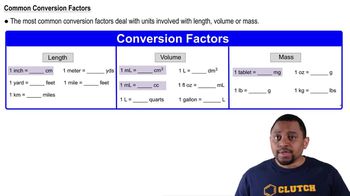
Understanding the conversion between milliliters (mL) and liters (L) is essential in volume calculations. Since 1 L equals 1000 mL, this conversion is often necessary when dealing with larger volumes or when results need to be expressed in different units. However, in this specific problem, the calculations remain in milliliters, simplifying the process.
Recommended video:
Guided course
02:10
Conversion Factors (Simplified) Concept 2
Related Practice
Textbook Question

A semipermeable membrane separates two compartments, A and B. If the levels in A and B are equal initially, select the diagram that illustrates the final levels in a to d:

<IMAGE>

1114
views
Textbook Question

Select the diagram that represents the shape of a red blood cell when placed in each of the following a to e: (9.6)

<IMAGE>

a. 0.9% (m/v) NaCl solution

1307
views
Textbook Question

Potassium nitrate has a solubility of 32 g of KNO3 in 100. g of H2O at 20 °C. Determine if each of the following forms an unsaturated or saturated solution at 20 °C:

a. adding 32 g of KNO3 to 200. g of H2O

2012
views
Textbook Question

In a laboratory experiment, a 10.0-mL sample of NaCl solution is poured into an evaporating dish with a mass of 24.10 g. The combined mass of the evaporating dish and NaCl solution is 36.15 g. After heating, the evaporating dish and dry NaCl have a combined mass of 25.50 g.

a. What is the mass percent (m/m) of the NaCl solution?

3015
views
2
rank
Textbook Question

In a laboratory experiment, a 10.0-mL sample of NaCl solution is poured into an evaporating dish with a mass of 24.10 g. The combined mass of the evaporating dish and NaCl solution is 36.15 g. After heating, the evaporating dish and dry NaCl have a combined mass of 25.50 g.

b. What is the molarity (M) of the NaCl solution?

1916
views
Textbook Question

In a laboratory experiment, a 10.0-mL sample of NaCl solution is poured into an evaporating dish with a mass of 24.10 g. The combined mass of the evaporating dish and NaCl solution is 36.15 g. After heating, the evaporating dish and dry NaCl have a combined mass of 25.50 g.

c. If water is added to 10.0 mL of the initial NaCl solution to give a final volume of 60.0 mL, what is the molarity of the diluted NaCl solution?

1872
views