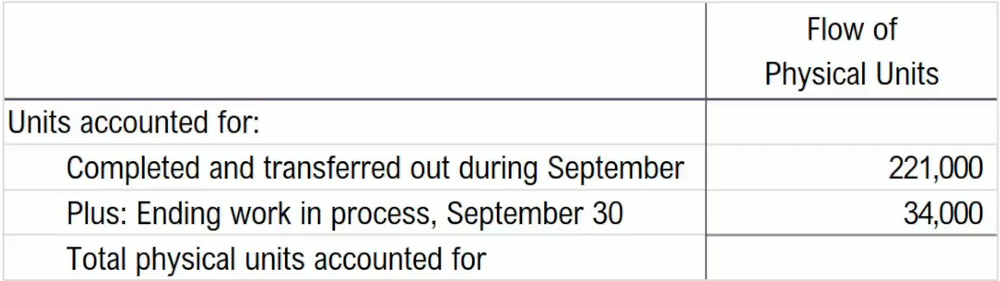
Assigning costs to units is a crucial step in cost accounting, particularly when preparing a cost reconciliation report. This process involves calculating the total cost of partially completed goods, known as ending work in process (WIP), as well as the cost of finished goods. To accurately assign costs, it is essential to use equivalent units, which represent the amount of work done on partially completed units expressed in fully completed units. These equivalent units are determined separately for conversion costs and direct materials.
First, identify the equivalent units for ending work in process from prior calculations. For example, if there are 50,000 equivalent units for conversion costs and 75,000 equivalent units for direct materials, these figures form the basis for cost assignment. Next, use the cost per equivalent unit, which is derived from the total costs divided by equivalent units of production. Suppose the conversion cost per equivalent unit is \$1 and the direct material cost per equivalent unit is \$0.25. Multiplying the equivalent units by their respective costs per equivalent unit gives the total costs assigned to ending WIP: \$50,000 for conversion costs (\$1 × 50,000) and \$18,750 for direct materials (\$0.25 × 75,000). The sum of these amounts, \$68,750, represents the total cost of the partially completed goods at the end of the period.
Similarly, for finished goods inventory, the same method applies but with different equivalent units. If the finished goods have 1,500,000 equivalent units for both conversion and direct materials, multiplying these by the same cost per equivalent unit results in \$1,500,000 for conversion costs and \$375,000 for direct materials. Adding these yields a total cost of \$1,875,000 for completed units.
These calculations are essential for preparing the cost reconciliation report, which reconciles the total costs accounted for during the period. The ending work in process cost becomes the beginning work in process cost for the next period, ensuring continuity in cost tracking. This relationship can be expressed by the formula for cost per equivalent unit:
\[ \text{Cost per Equivalent Unit} = \frac{\text{Cost of Beginning Work in Process} + \text{Cost Added During the Period}}{\text{Equivalent Units of Production}} \]Organizing these figures into a clear chart helps maintain accuracy and clarity. For example, listing conversion costs and direct material costs separately for both ending work in process and completed units, along with their totals, provides a structured overview. This systematic approach not only aids in accurate cost assignment but also supports effective decision-making and financial reporting in manufacturing and production environments.