Unit Product Cost: Videos & Practice Problems
Unit Product Cost compares how manufacturing costs are assigned under absorption costing and variable costing. Both methods include direct materials, direct labor, and variable manufacturing overhead in product cost. The key difference is fixed overhead: absorption costing treats fixed manufacturing overhead as part of the unit product cost, while variable costing does not. Selling and administrative costs, whether variable or fixed, are period costs and are not included in unit product cost.
To determine the cost per unit, variable manufacturing costs are added per unit, and under absorption costing fixed manufacturing overhead is also spread across units using \( \frac{\text{Total fixed manufacturing overhead}}{\text{Units produced}} \) . This makes absorption costing produce a higher unit product cost than variable costing whenever fixed manufacturing overhead exists. A further distinction is that variable costing uses actual overhead data rather than predetermined overhead for unit product cost.
Calculating Unit Product Cost

Calculating Unit Product Cost
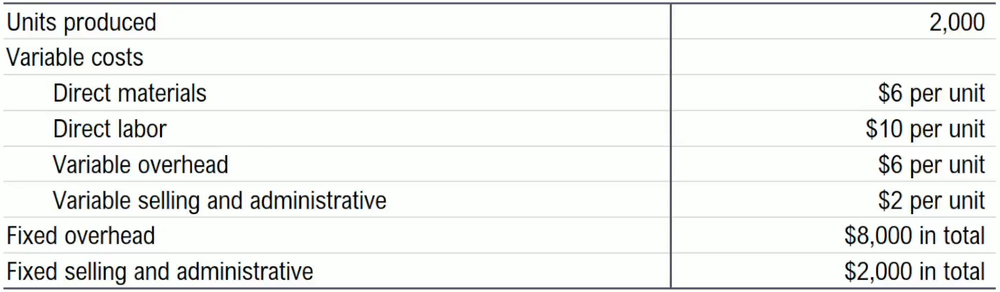
Calculate the product cost per unit under absorption costing.
20
22
24
26
Here's what students ask on this topic:
Absorption costing and variable costing differ primarily in how they treat fixed manufacturing overhead. Absorption costing includes fixed manufacturing overhead as part of the unit product cost, spreading the total fixed overhead across all units produced using the formula . Variable costing, on the other hand, excludes fixed manufacturing overhead from the unit product cost and only includes variable manufacturing costs such as direct materials, direct labor, and variable overhead. Both methods exclude selling and administrative costs, whether fixed or variable, as these are period costs. As a result, absorption costing typically results in a higher unit product cost compared to variable costing when fixed overhead exists.
To calculate unit product cost under absorption costing, you add all manufacturing costs, including direct materials, direct labor, variable manufacturing overhead, and fixed manufacturing overhead allocated per unit. The fixed overhead per unit is calculated by dividing total fixed manufacturing overhead by the number of units produced: . Then, sum all these costs per unit to get the total unit product cost. For example, if direct materials cost \$1, direct labor \$1, variable overhead \$0.75, and fixed overhead allocated per unit is \$0.25, the total unit product cost would be \$3.00. This method ensures all manufacturing costs are absorbed into the product cost.
Selling and administrative costs, whether fixed or variable, are considered period costs and are not included in the unit product cost under either absorption or variable costing. This is because these costs are not directly tied to the manufacturing process or production of goods. Instead, they are related to the overall operation and management of the business and are expensed in the period incurred. Including them in product cost would distort the true cost of manufacturing and affect decision-making related to production efficiency and pricing.
Fixed overhead is the key factor that causes the difference between absorption and variable costing unit product costs. Under absorption costing, fixed manufacturing overhead is allocated to each unit produced, increasing the unit product cost. In contrast, variable costing excludes fixed overhead from the unit product cost, treating it as a period expense instead. Therefore, when fixed overhead exists, absorption costing will always show a higher unit product cost than variable costing. The difference per unit is calculated by dividing total fixed overhead by the number of units produced, which can significantly impact financial reporting and inventory valuation when production volumes are large.
No, variable costing does not use predetermined overhead rates for calculating unit product cost. Instead, it relies on actual overhead costs incurred during the period. This means that only the actual variable manufacturing overhead costs are included in the unit product cost. Predetermined overhead rates are typically used in absorption costing to allocate both fixed and variable overhead costs to products based on estimated activity levels. Variable costing’s reliance on actual overhead ensures that the unit product cost reflects true variable manufacturing costs without allocating fixed overhead.