
Ch. 8 - Microbial Genetics
Tortora - Microbiology: An Introduction 14th Edition
Tortora14th EditionMicrobiology: An IntroductionISBN: 9780138200398Not the one you use?Change textbook
Chapter 8, Problem 6

Plasmids differ from transposons in that plasmids
a. become inserted into chromosomes.
b. are self-replicated outside the chromosome.
c. move from chromosome to chromosome.
d. carry genes for antibiotic resistance.
e. none of the above

Verified step by step guidance
1
Understand the definitions of plasmids and transposons: Plasmids are small, circular DNA molecules that replicate independently of the bacterial chromosome, while transposons are DNA sequences that can move from one location to another within the genome.
Analyze option (a): 'become inserted into chromosomes.' Transposons typically insert themselves into chromosomes, but plasmids usually exist independently, so this is more characteristic of transposons.
Analyze option (b): 'are self-replicated outside the chromosome.' Plasmids have their own origin of replication and can replicate independently in the cytoplasm, which is a key difference from transposons.
Analyze option (c): 'move from chromosome to chromosome.' This describes transposons, which can jump between chromosomal locations, not plasmids.
Analyze option (d): 'carry genes for antibiotic resistance.' Both plasmids and transposons can carry antibiotic resistance genes, so this is not a distinguishing feature.

Verified video answer for a similar problem:

This video solution was recommended by our tutors as helpful for the problem above.
Video duration:
2m
Was this helpful?

Key Concepts

Here are the essential concepts you must grasp in order to answer the question correctly.

Plasmids

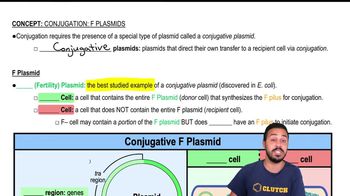
Plasmids are small, circular DNA molecules found in bacteria that replicate independently of the chromosomal DNA. They often carry genes that provide advantages, such as antibiotic resistance, and can be transferred between bacteria through processes like conjugation.
Recommended video:

Transposons

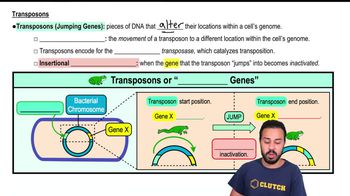
Transposons, or 'jumping genes,' are DNA sequences that can move from one location to another within a genome, including between chromosomes or plasmids. Unlike plasmids, they do not replicate independently but integrate into the host DNA.
Recommended video:
Guided course
04:19
Transposons in Prokaryotes

Differences between Plasmids and Transposons

The key difference is that plasmids replicate autonomously outside the chromosome, while transposons move within the genome but do not self-replicate independently. Both can carry genes like those for antibiotic resistance, but their mobility and replication mechanisms differ.
Recommended video:
Related Practice
Textbook Question

Identify when (before transcription, after transcription but before translation, after translation) each of the following regulatory mechanisms functions.

a. ATP combines with an enzyme, altering its shape.

b. A short RNA is synthesized that is complementary to mRNA.

c. Methylation of DNA occurs.

d. An inducer combines with a repressor.

1290
views
Textbook Question

Use the following choices to answer the question:

a. Catabolite repression

b. DNA polymerase

c. Induction

d. Repression

e. Translation


Mechanism by which the presence of glucose inhibits the lac operon.

1199
views
Textbook Question

The following is a code for a strand of DNA.

a. Using the genetic code provided in Figure 8.8, fill in the blanks to complete the segment of DNA shown.

b. Fill in the blanks to complete the sequence of amino acids coded for by this strand of DNA.

c. Write the code for the complementary strand of DNA completed in part (a).

d. What would be the effect if C were substituted for T at base 10?

e. What would be the effect if A were substituted for G at base 11?

f. What would be the effect if G were substituted for T at base 14?

g. What would be the effect if C were inserted between bases 9 and 10?

h. How would UV radiation affect this strand of DNA?

i. Identify a nonsense sequence in this strand of DNA.

1491
views
Textbook Question

Which sequence is the best target for damage by UV radiation: AGGCAA, CTTTGA, or GUAAAU? Why aren’t all bacteria killed when they are exposed to sunlight?

1621
views
Textbook Question

Suppose you inoculate three flasks of minimal salts broth with E. coli. Flask A contains glucose. Flask B contains glucose and lactose. Flask C contains lactose. After a few hours of incubation, you test the flasks for the presence of ß-galactosidase. Which flask(s) do you predict will have this enzyme?

a. A

b. B

c. C

d. A and B

e. B and C

1524
views
Textbook Question

Bacteria can acquire antibiotic resistance by all of the following except

a. mutation.

b. insertion of transposons.

c. conjugation.

d. snRNPs.

e. transformation.

1881
views