Ch. 1 - Introduction to Microbiology
Chapter 1, Problem 17

List the following taxonomic groupings in order from general to specific.
Phylum, Kingdom, Genus, Family, Class, Domain, Species, Order

Verified step by step guidance
1
Understand that taxonomic classification in biology is hierarchical, starting from the most general category and moving to the most specific.
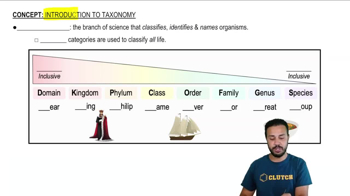
Recall the standard taxonomic ranks in order from broadest to most specific: Domain, Kingdom, Phylum, Class, Order, Family, Genus, Species.
Identify each of the given taxonomic groupings and place them according to this hierarchy.
Arrange the list as: Domain, Kingdom, Phylum, Class, Order, Family, Genus, Species.
Verify that the sequence moves from the broadest grouping (Domain) to the most specific (Species), which is the correct order from general to specific.

Verified video answer for a similar problem:

This video solution was recommended by our tutors as helpful for the problem above.
Video duration:
2m
Was this helpful?

Key Concepts

Here are the essential concepts you must grasp in order to answer the question correctly.

Taxonomic Hierarchy

Taxonomic hierarchy is the system used to classify and organize living organisms into nested groups based on shared characteristics. It ranges from broad categories like Domain and Kingdom to specific ones like Genus and Species, helping scientists understand evolutionary relationships.
Recommended video:
Guided course
03:09
Hierarchy of Microbial Growth Control Terminology

Levels of Classification

The main levels of biological classification, from general to specific, are Domain, Kingdom, Phylum, Class, Order, Family, Genus, and Species. Each level narrows down organisms into more closely related groups, with Species being the most specific classification.
Recommended video:
Guided course
03:00
Substrate-Level Phosphorylation

Importance of Specificity in Taxonomy

Specificity in taxonomy allows precise identification and study of organisms. As you move from general to specific levels, organisms share more traits and genetic similarities, which is crucial for research, communication, and understanding biodiversity.
Recommended video:
Guided course
02:19
Introduction to Taxonomy
Related Practice
Textbook Question

Classify the following as bright field, dark field, phase contrast, or differential interference contrast (DIC).

a. Sample must be stained or have its own coloration to be seen:

b. Specimen is illuminated with polarized light:

c. Generates a falsely three-dimensional image:

d. The simplest and most common form of light microscopy:

e. Generates a negative image using a hollow cone of light:

f. Generates a negative image in which light shifts are converted into visible changes in brightness and contrast:

572
views
Textbook Question

Which of the following is/are true regarding our normal microbiota? Select all that apply.

a. Our normal microbiota is easily disrupted by hygiene practices like hand washing.

b. Our normal microbiota can include pathogens.

c. Normal microbiota compete with pathogens.

d. Normal microbiota may colonize us before we are even born.

e. Normal microbiota changes over time.

f. The normal microbiota that we have as adults is the same as we had as children.

g. The normal microbiota of the gut is similar to that of the skin.

951
views
Textbook Question

Immersion oil improves resolution by:

a. Limiting light refraction.

b. Magnifying the specimen.

c. Improving specimen contrast.

d. Making light waves shorter.

e. Making light waves faster.

955
views
Textbook Question

Acanthamoeba protozoa species are associated with:

a. keratitis.

b. conjunctivitis.

c. river blindness.

d. trachoma.

e. all of the above.

637
views
Textbook Question

Why is it clinically helpful to know the Gram property of an organism?

800
views
Textbook Question

The protists Trypanosoma brucei, Naegleria fowleri, and Toxoplasma gondii

a. invade host cells to cause cellular damage.

b. are only infective in the flagellated form.

c. have a nucleus and are eukaryotic.

d. have all of the above characteristics.

652
views