Ch. 10 - Host Microbe Interactions and Pathogenesis
Chapter 10, Problem 8

What is a reservoir, and why can C. difficile use a fomite as an effective environmental reservoir?

Verified step by step guidance
1
Step 1: Define the term 'reservoir' in the context of microbiology. A reservoir is any person, animal, plant, soil, or substance in which an infectious agent normally lives and multiplies, serving as a source from which other individuals can be infected.
Step 2: Explain what a fomite is. A fomite is an inanimate object or surface that can become contaminated with infectious agents and serve as a vehicle for transmission.
Step 3: Describe the characteristics of Clostridioides difficile (C. difficile) that allow it to survive outside the host. C. difficile forms spores, which are highly resistant to environmental stresses such as heat, desiccation, and disinfectants.
Step 4: Connect the spore-forming ability of C. difficile to its survival on fomites. Because spores can persist on surfaces for long periods, fomites can act as effective environmental reservoirs by harboring these spores.
Step 5: Summarize why fomites are effective reservoirs for C. difficile. The durability of C. difficile spores on fomites allows the bacteria to remain viable in the environment, facilitating transmission to new hosts when they come into contact with contaminated surfaces.

Verified video answer for a similar problem:

This video solution was recommended by our tutors as helpful for the problem above.
Video duration:
1m
Was this helpful?

Key Concepts

Here are the essential concepts you must grasp in order to answer the question correctly.

Reservoir in Microbiology

A reservoir is any habitat—living or non-living—where a pathogen normally lives, grows, and multiplies. It serves as a source from which the pathogen can be transmitted to a susceptible host. Understanding reservoirs is crucial for controlling infectious diseases.
Recommended video:
Guided course
07:27
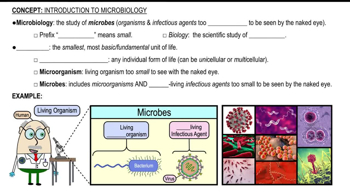
Introduction to Microbiology

Fomites as Environmental Reservoirs

Fomites are inanimate objects like doorknobs, medical equipment, or surfaces that can harbor infectious agents. They act as environmental reservoirs by allowing pathogens to survive outside a host, facilitating indirect transmission to new hosts.
Recommended video:
Guided course
07:21
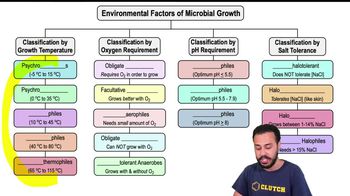
Reviewing the Environmental Factors of Microbial Growth

Clostridioides difficile Survival and Transmission

C. difficile forms hardy spores that resist disinfectants and environmental stresses, enabling it to persist on fomites for long periods. This spore-forming ability makes fomites effective reservoirs, contributing to the spread of C. difficile infections in healthcare settings.
Recommended video:
Guided course
04:18
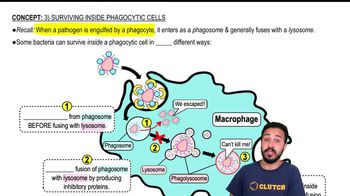
Surviving Inside Phagocytic Cells
Related Practice
Textbook Question

Indicate the true statements and then correct the false statements so that they are true.

a. HIV is transmitted by a parenteral route.

b. Candida albicans is an opportunistic pathogen that can cause disease in an immune-competent host if the normal microbiota are disrupted.

c. Gram-positive bacteria may produce endotoxin.

d. Siderophores help pathogens obtain calcium.

e. Emerging pathogens tend to exhibit expanded tropism.

f. The more toxic a substance is, the higher its LD50.

g. Virulence is the ability of a microbe to cause disease.

h. Gram-negative bacteria may produce exotoxins.

4
views
Textbook Question

Select the false statement about normal microbiota.

a. They compete with pathogens.

b. They do not include potential pathogens.

c. They make vitamins for the host.

d. They train the immune system.

e. A disruption in their balance can lead to disease.

727
views
Textbook Question

Pili, fimbriae, and sialic acid binding factors are examples of ________, which are virulence factors that allow pathogens to ________ host tissues––an essential early step in pathogenesis. In contrast, flagella, collagenases, and coagulases tend to act as ________, which help pathogens spread deeper into host tissues.

600
views
Textbook Question

Toxigenic microbes produce _______. A high ID50 would suggest _______, and a low LD50 would suggest _______.

617
views
Textbook Question

A pathogen that makes endotoxin, enters through the fecal–oral route, and lacks a nucleus is most likely a

a. Virus.

b. Gram-positive bacterium.

c. Gram-negative bacterium.

d. Protozoan pathogen.

e. There is not enough information to answer this question.

591
views
Textbook Question

Complete the table:

834
views