
Pearson+ LogoPearson+ Logo
Ch. 7 - Fundamentals of Microbial Growth
Norman-McKay- Microbiology: Basic and Clinical Principles 2nd Edition
Norman-McKay2nd EditionMicrobiology: Basic and Clinical PrinciplesISBN: 9780137661619Not the one you use?Change textbook
Chapter 7, Problem 8

Which direct enumeration method differentiates living from nonliving cells?
a. Manual cell counts
b. Measuring dry weight of cells
c. Viable plate count
d. Measuring biochemical activity
e. Coulter counter

Verified step by step guidance
1
Understand that direct enumeration methods involve counting cells directly, either visually or instrumentally, rather than estimating based on indirect measures.
Recognize that some methods count all cells present, regardless of whether they are alive or dead, while others specifically count only living cells.
Manual cell counts (option a) and Coulter counters (option e) count all cells, living or dead, because they rely on visual or electronic detection without assessing viability.
Viable plate count (option c) involves spreading a diluted sample on a nutrient agar plate and counting the number of colonies that grow, which represent living cells capable of reproduction.
Therefore, the method that differentiates living from nonliving cells is the viable plate count, as it only counts cells that can form colonies.

Verified video answer for a similar problem:

This video solution was recommended by our tutors as helpful for the problem above.
Video duration:
2m
Was this helpful?

Key Concepts

Here are the essential concepts you must grasp in order to answer the question correctly.

Direct Enumeration Methods

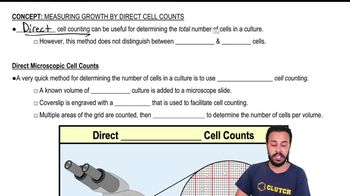
Direct enumeration methods involve counting cells individually, either manually or with instruments. These methods provide a total cell count but may not distinguish between living and dead cells unless combined with viability indicators.
Recommended video:
Guided course
03:28
Direct Microscopic Cell Counts

Viable Plate Count

Viable plate count measures only living cells by culturing them on nutrient media. Each colony arises from a single viable cell, allowing quantification of living microorganisms, unlike total counts that include dead cells.
Recommended video:
Guided course
01:36
Measuring Growth by Plate Counts

Distinguishing Living from Nonliving Cells

Differentiating living from nonliving cells requires methods that assess metabolic activity or the ability to reproduce. Techniques like viable plate counts or staining methods target only living cells, unlike physical counts or biomass measurements.
Recommended video:
Guided course
03:47
DNA Polymerase Distinguishes Template from New Strand via Methylation
Related Practice
Textbook Question

Choose the false statement about binary fission.

a. It generates genetically diverse daughter cells.

b. It is an asexual form of reproduction.

c. It is the most common way that prokaryotes divide.

d. It leads to exponential population growth.

e. If it occurs in a single plane, it could generate chains of bacteria.

745
views
Textbook Question

Match the term to the proper description(s). A term can have more than one description.

600
views
Textbook Question

In a closed batch system, not all cells are expected to die, even as the death phase advances. Why?

589
views
Textbook Question

Match the term to the proper description(s). A term can have more than one description.

572
views
Textbook Question

You are collecting a clinical sample for microbiological analysis. Which of the following is the most important thing you must do?

a. Follow aseptic protocols.

b. Refrigerate the samples immediately after collection.

c. Determine if the potential pathogen is an aerobe or strict anaerobe.

d. Determine if normal flora have been removed before the sample is collected.

466
views
Textbook Question

Label each statement that follows as true or false, and correct the false statements so they are true:

a. Most pathogens would be considered mesophilic alkaliphiles.

b. Sterilization is a form of decontamination.

c. Disinfection is a form of decontamination.

d. High-level germicides achieve sterilization.

e. Ionizing radiation is a form of chemical microbial control.

f. Standard pasteurization is a way to sterilize milk.

551
views