Back
Back
Problem 1
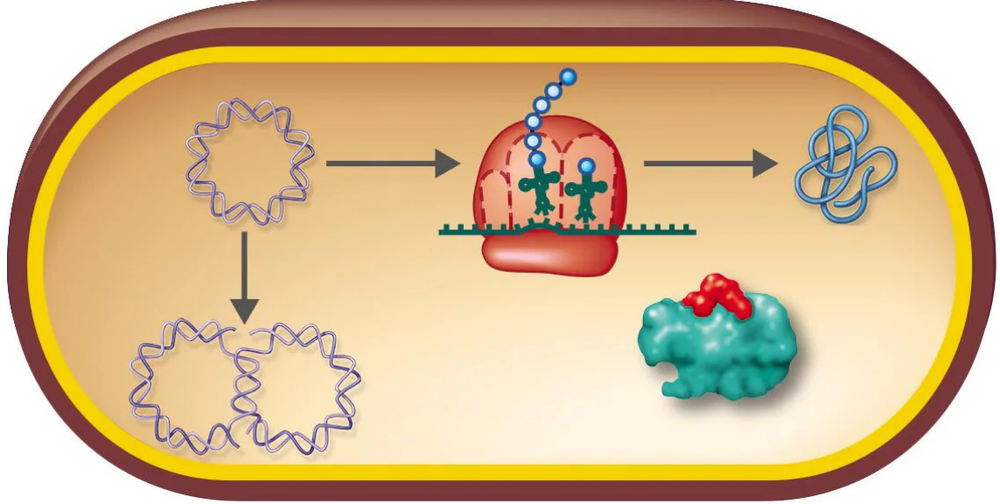
Show where the following antibiotics work: ciprofloxacin, tetracycline, streptomycin, vancomycin, polymyxin B, sulfanilamide, rifampin, erythromycin.
Problem 2
List and explain five criteria used to identify an effective antimicrobial agent.
Problem 4
Define drug resistance. How is it produced? What measures can be taken to minimize drug resistance?
Problem 5
List the advantages of using two chemotherapeutic agents simultaneously to treat a disease. What problem can occur when two drugs are used?
Problem 6
Why does a cell die from the following antimicrobial actions?
a. Colistimethate binds to phospholipids.
b. Kanamycin binds to 70S ribosomes.
Problem 7
How does each of the following inhibit translation?
a. Chloramphenicol
b. Erythromycin
c. Tetracycline
d. Streptomycin
e. Oxazolidinone
f. Streptogramin
Problem 9
Compare the method of action of the following pairs:
a. Penicillin and echinocandin
b. Imidazole and polymyxin B
Problem 10
This microorganism is not susceptible to antibiotics or neuromuscular blocks, but is susceptible to protease inhibitors.
Problem 1
Which of the following pairs is mismatched?
a. Antihelminthic—inhibition of oxidative phosphorylation
b. Antihelminthic—inhibition of cell wall synthesis
c. Antifungal—injury to plasma membrane
d. Antifungal—inhibition of mitosis
e. Antiviral—inhibition of DNA synthesis
Problem 2
All of the following are modes of action of antiviral drugs except:
a. Inhibition of protein synthesis at 70S ribosomes
b. Inhibition of DNA synthesis
c. Inhibition of RNA synthesis
d. Inhibition of uncoating
e. All of the above are modes of action of antiviral drugs
Problem 3
Which of the following modes of action would not be fungicidal?
a. Inhibition of peptidoglycan synthesis
b. Inhibition of mitosis
c. Injury to the plasma membrane
d. Inhibition of nucleic acid synthesis
e. All of the above are fungicidal modes of action
Problem 4
An antimicrobial agent should meet all of the following criteria except:
a. Selective toxicity
b. The production of hypersensitivities
c. A narrow spectrum of activity
d. No production of drug resistance
e. All of the above are necessary criteria for an antimicrobial
Problem 5
The most selective antimicrobial activity would be exhibited by a drug that:
a. Inhibits cell wall synthesis
b. Inhibits protein synthesis
c. Injures the plasma membrane
d. Inhibits nucleic acid synthesis
e. All of the above
Problem 6
Antibiotics that inhibit translation have side effects:
a. Because all cells have proteins
b. Only in the few cells that make proteins
c. Because eukaryotic cells have 80S ribosomes
d. At the 70S ribosomes in eukaryotic cells
e. None of the above is correct
Problem 7
Which of the following will not affect eukaryotic cells?
a. Inhibition of the mitotic spindle
b. Binding with sterols
c. Binding to 80S ribosomes
d. Binding to DNA
e. All of the above will affect them
Problem 8
Cell membrane damage causes death because
a. The cell undergoes osmotic lysis.
b. Cell contents leak out.
c. The cell plasmolyzes.
d. The cell lacks a wall.
e. None of the above is correct.
Problem 9
A drug that intercalates into DNA has the following effects. Which one leads to the others?
a. It disrupts transcription
b. It disrupts translation
c. It interferes with DNA replication
d. It causes mutations
e. It alters proteins
Problem 10
Chloramphenicol binds to the 50S portion of a ribosome, which will interfere with:
a. Transcription in prokaryotic cells
b. Transcription in eukaryotic cells
c. Translation in prokaryotic cells
d. Translation in eukaryotic cells
e. DNA synthesis