Ch 20: The Micro/Macro Connection
Knight Calc - Physics for Scientists and Engineers 5th Edition
Knight Calc5th EditionPhysics for Scientists and EngineersISBN: 9780137344796Not the one you use?Change textbook
Chapter 20, Problem 54

On earth, STP is based on the average atmospheric pressure at the surface and on a phase change of water that occurs at an easily produced temperature, being only slightly cooler than the average air temperature. The atmosphere of Venus is almost entirely carbon dioxide (CO2), the pressure at the surface is a staggering 93 atm, and the average temperature is 470℃. Venusian scientists, if they existed, would certainly use the surface pressure as part of their definition of STP. To complete the definition, they would seek a phase change that occurs near the average temperature. Conveniently, the melting point of the element tellurium is 450℃. What are (a) the rms speed and (b) the mean free path of carbon dioxide molecules at Venusian STP based on this phase change in tellurium? The radius of a CO2 molecule is 1.5 x 10⁻¹⁰ m.

Verified step by step guidance
1
Step 1: To calculate the root mean square (rms) speed of carbon dioxide (CO₂) molecules, use the formula: 3kTm, where k is the Boltzmann constant (1.38×10⁻²³ J·K-1), T is the temperature in kelvins, and m is the mass of a CO₂ molecule. First, convert the temperature from Celsius to kelvins using T=470+273.
Step 2: Determine the mass of a single CO₂ molecule. The molar mass of CO₂ is approximately 44 g·mol-1. Convert this to kilograms per molecule by dividing by Avogadro's number (6.022×10²³).
Step 3: Substitute the values of k, T, and m into the rms speed formula to calculate the root mean square speed of CO₂ molecules.
Step 4: To calculate the mean free path of CO₂ molecules, use the formula: λ=1π×2×r2×n, where r is the radius of a CO₂ molecule and n is the number density of molecules. The radius is given as 1.5×10⁻¹⁰ m.
Step 5: Calculate the number density n using the ideal gas law: n=Pk×T, where P is the pressure (93 atm, converted to pascals). Substitute the values of r and n into the mean free path formula to find the result.

Verified video answer for a similar problem:

This video solution was recommended by our tutors as helpful for the problem above.
Video duration:
8m
Was this helpful?

Key Concepts

Here are the essential concepts you must grasp in order to answer the question correctly.

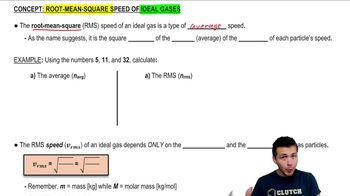
Root Mean Square Speed (rms speed)

The root mean square speed is a measure of the average speed of particles in a gas, calculated from the kinetic theory of gases. It is defined as the square root of the average of the squares of the speeds of the gas molecules. The rms speed is influenced by the temperature and molar mass of the gas, providing insight into the kinetic energy and behavior of gas molecules under different conditions.
Recommended video:
Guided course
05:21
Root-Mean-Square Speed of Ideal Gases

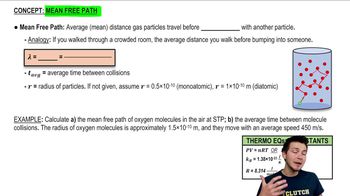
Mean Free Path

Mean free path is the average distance a molecule travels between collisions with other molecules in a gas. It is influenced by the density of the gas and the size of the molecules. Understanding mean free path is crucial for predicting gas behavior, especially in high-pressure environments like Venus, where the density of CO₂ is significantly higher than on Earth.
Recommended video:
Guided course
08:20
Mean Free Path

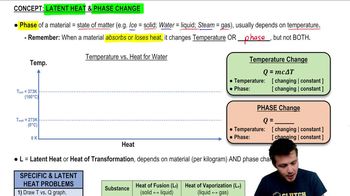
Phase Change

A phase change refers to the transition of a substance from one state of matter to another, such as solid to liquid or liquid to gas. In the context of the question, the phase change of tellurium at 450℃ is relevant for defining standard temperature and pressure (STP) on Venus. This concept is essential for understanding how temperature and pressure conditions affect the physical properties and behavior of gases in different planetary atmospheres.
Recommended video:
Guided course
10:40
Latent Heat & Phase Changes
Related Practice
Textbook Question

5.0 x 10²³ nitrogen molecules collide with a 10 cm2 wall each second. Assume that the molecules all travel with a speed of 400 m/s and strike the wall head-on. What is the pressure on the wall?

1416
views

Textbook Question

Uranium has two naturally occurring isotopes. 238U^{238}\(\text{U}\) has a natural abundance of 99.3%99.3\% and 235U^{235}\(\text{U}\) has an abundance of 0.7%0.7\%. It is the rarer 235U^{235}\(\text{U}\) that is needed for nuclear reactors. The isotopes are separated by forming uranium hexafluoride, UF6\(\text{UF}\)_6, which is a gas, then allowing it to diffuse through a series of porous membranes. 235UF6^{235}UF_6 has a slightly larger rms speed than 238UF6^{238}UF_6 and diffuses slightly faster. Many repetitions of this procedure gradually separate the two isotopes. What is the ratio of the rms speed of 235UF6^{235}UF_6 to that of 238UF6^{238}UF_6?

1189
views
Textbook Question

A gas cylinder has a piston at one end that is moving outward at speed vpiston during an isobaric expansion of the gas. Find an expression for the rate at which vrms is changing in terms of vpiston, the instantaneous value of vrms, and the instantaneous value L of the length of the cylinder.

1247
views
Textbook Question

A 100 cm³ box contains helium at a pressure of 2.0 atm and a temperature of 100℃. It is placed in thermal contact with a 200 cm³ box containing argon at a pressure of 4.0 atm and a temperature of 400℃. What is the final thermal energy of each gas?

1912
views
Textbook Question

Equation 20.3 is the mean free path of a particle through a gas of identical particles of equal radius. An electron can be thought of as a point particle with zero radius. Electrons travel 3.0 km through the Stanford Linear Accelerator. In order for scattering losses to be negligible, the pressure inside the accelerator tube must be reduced to the point where the mean free path is at least 50 km. What is the maximum possible pressure inside the accelerator tube, assuming T = 20℃? Give your answer in both Pa and atm.

1988
views
Textbook Question

FIGURE P20.57 shows the thermal energy of 0.14 mol of gas as a function of temperature. What is Cᵥ for this gas?

257
views