

Ch 30: Electromagnetic Induction
Knight Calc - Physics for Scientists and Engineers 5th Edition
Knight Calc5th EditionPhysics for Scientists and EngineersISBN: 9780137344796Not the one you use?Change textbook
Chapter 30, Problem 13

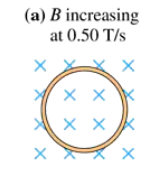
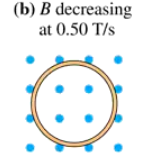
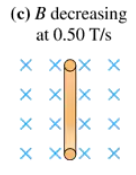
FIGURE EX30.13 shows a 10-cm-diameter loop in three different magnetic fields. The loop's resistance is 0.20 Ω. For each, what are the size and direction of the induced current?

Verified step by step guidance
1
Step 1: Understand Faraday's Law of Induction, which states that the induced electromotive force (EMF) in a loop is proportional to the rate of change of magnetic flux through the loop. The formula is: ε=−dΦBdt, where ΦB is the magnetic flux.
Step 2: Calculate the magnetic flux for each case. Magnetic flux is given by the formula: ΦB=BAcosθ, where B is the magnetic field strength, A is the area of the loop, and θ is the angle between the magnetic field and the normal to the loop.
Step 3: Determine the rate of change of magnetic flux (dΦBdt) for each scenario. If the magnetic field is changing, calculate the change in B over time. If the field is constant, the induced EMF will be zero.
Step 4: Use Ohm's Law to calculate the induced current. The formula is: I=εR, where ε is the induced EMF and R is the resistance of the loop (given as 0.20 Ω).
Step 5: Determine the direction of the induced current using Lenz's Law. Lenz's Law states that the induced current will flow in a direction that opposes the change in magnetic flux. Analyze the direction of the changing magnetic field in each case to determine the current's direction.

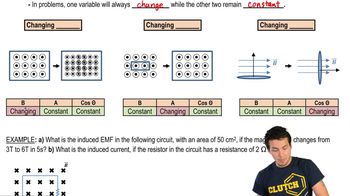
Verified video answer for a similar problem:

This video solution was recommended by our tutors as helpful for the problem above.
Video duration:
5m
Was this helpful?

Key Concepts

Here are the essential concepts you must grasp in order to answer the question correctly.

Faraday's Law of Electromagnetic Induction

Faraday's Law states that a change in magnetic flux through a loop induces an electromotive force (EMF) in the loop. The induced EMF is proportional to the rate of change of the magnetic flux, which can occur due to a changing magnetic field or the movement of the loop within a magnetic field. This principle is fundamental for understanding how currents are generated in conductive loops.
Recommended video:
Guided course
09:26
Faraday's Law

Lenz's Law

Lenz's Law provides the direction of the induced current resulting from electromagnetic induction. It states that the induced current will flow in a direction that opposes the change in magnetic flux that produced it. This law ensures the conservation of energy and helps predict the behavior of induced currents in various scenarios.
Recommended video:

Ohm's Law

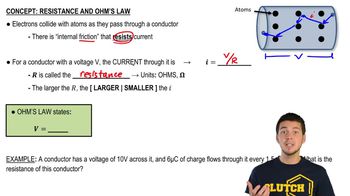
Ohm's Law relates the voltage (V), current (I), and resistance (R) in an electrical circuit, expressed as V = IR. In the context of induced currents, once the induced EMF is calculated using Faraday's Law, Ohm's Law can be used to determine the size of the current flowing through the loop by dividing the induced EMF by the loop's resistance.
Recommended video:
Guided course
03:07
Resistance and Ohm's Law
Related Practice
Textbook Question

An equilateral triangle 8.0 cm on a side is in a 5.0 mT uniform magnetic field. The magnetic flux through the triangle is 6.0 μWb. What is the angle between the magnetic field and an axis perpendicular to the plane of the triangle?

176
views
Textbook Question

CALC A 5.0-cm-diameter coil has 20 turns and a resistance of 0.50 Ω. A magnetic field perpendicular to the coil is B = 0.020t + 0.010t2, where B is in tesla and t is in seconds. Find an expression for the induced current I(t) as a function of time.

1948
views
Textbook Question

FIGURE EX30.8 shows a 2.0-cm-diameter solenoid passing through the center of a 6.0-cm-diameter loop. The magnetic field inside the solenoid is 0.20 T. What is the magnitude of the magnetic flux through the loop when it is perpendicular to the solenoid and when it is tilted at a 60° angle?

125
views
Textbook Question

A solenoid is wound as shown in FIGURE EX30.9. Is there an induced current as magnet 2 is moved away from the solenoid? If so, what is the current direction through resistor R?

159
views
Textbook Question

A 1000-turn coil of wire 1.0 cm in diameter is in a magnetic field that increases from 0.10 T to 0.30 T in 10 ms. The axis of the coil is parallel to the field. What is the emf of the coil?

2168
views
Textbook Question

CALC A 5.0-cm-diameter coil has 20 turns and a resistance of 0.50 Ω. A magnetic field perpendicular to the coil is B = 0.020t + 0.010t2, where B is in tesla and t is in seconds. Evaluate I at t = 5 s and t = 10 s.

1272
views