Ch 16: Sound & Hearing
Young & Freedman Calc - University Physics 14th Edition
Young & Freedman Calc14th EditionUniversity PhysicsISBN: 9780321973610Not the one you use?Change textbook
Chapter 16, Problem 34a

Small speakers A and B are driven in phase at 725 Hz by the same audio oscillator. Both speakers start out 4.50 m from the listener, but speaker A is slowly moved away (Fig. E16.34). At what distance d will the sound from the speakers first produce destructive interference at the listener's location?
<Image>

Verified step by step guidance
1
Understand that destructive interference occurs when the path difference between two waves is an odd multiple of half wavelengths, i.e., (2n+1)λ/2, where n is an integer.
Calculate the wavelength (λ) of the sound using the formula λ = v/f, where v is the speed of sound in air (approximately 343 m/s) and f is the frequency of the sound (725 Hz).
Determine the initial path difference between the two speakers and the listener. Initially, both speakers are 4.50 m from the listener, so the path difference is zero.
As speaker A is moved away, calculate the new path difference, which is the difference in distance from speaker A to the listener and speaker B to the listener. This is given by (x + 3.20 m) - 3.20 m = x.
Set the path difference x equal to the first instance of destructive interference, which is λ/2, and solve for x to find the distance d that speaker A must be moved to achieve this condition.

Verified video answer for a similar problem:

This video solution was recommended by our tutors as helpful for the problem above.
Video duration:
6m
Was this helpful?

Key Concepts

Here are the essential concepts you must grasp in order to answer the question correctly.

Wave Interference

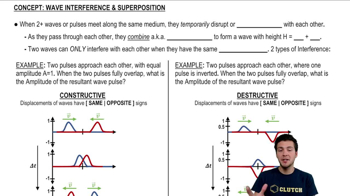
Wave interference occurs when two or more waves overlap and combine to form a new wave pattern. In this scenario, the sound waves from speakers A and B interfere with each other. Destructive interference happens when the waves are out of phase, leading to a reduction in amplitude, which can result in silence or a decrease in sound intensity at the listener's location.
Recommended video:
Guided course
03:47
Wave Interference & Superposition

Path Difference

Path difference refers to the difference in the distance traveled by two waves from their sources to a common point. For destructive interference to occur, the path difference must be an odd multiple of half the wavelength (λ/2, 3λ/2, etc.). This condition ensures that the waves arrive out of phase, canceling each other out at the listener's position.
Recommended video:
Guided course
08:20
Mean Free Path

Frequency and Wavelength Relationship

The frequency of a wave is related to its wavelength and the speed of sound in the medium by the equation v = fλ, where v is the speed of sound, f is the frequency, and λ is the wavelength. Given the frequency of 725 Hz and assuming the speed of sound in air is approximately 343 m/s, the wavelength can be calculated, which is crucial for determining the path difference needed for destructive interference.
Recommended video:
Guided course
05:08
Circumference, Period, and Frequency in UCM
Related Practice
Textbook Question

The fundamental frequency of a pipe that is open at both ends is 524 Hz. If one end is now closed, find the wavelength

2856
views

Textbook Question

Small speakers A and B are driven in phase at 725 Hz by the same audio oscillator. Both speakers start out 4.50 m from the listener, but speaker A is slowly moved away (Fig. E16.34)<IMAGE>. If A is moved even farther away than in part (a), at what distance d will the speakers next produce destructive interference at the listener’s location?

253
views
Textbook Question

The fundamental frequency of a pipe that is open at both ends is 524 Hz. How long is this pipe? If one end is now closed

3367
views
1
rank
Textbook Question

Two loudspeakers, A and B (Fig. E16.35), are driven by the same amplifier and emit sinusoidal waves in phase. Speaker B is 2.00 m to the right of speaker A. Consider point Q along the extension of the line connecting the speakers, 1.00 m to the right of speaker B. Both speakers emit sound waves that travel directly from the speaker to point Q. What is the lowest frequency for which constructive interference occurs at point Q?

3062
views
Textbook Question

Two loudspeakers, A and B (Fig. E16.35), are driven by the same amplifier and emit sinusoidal waves in phase. Speaker B is 2.00 m to the right of speaker A. Consider point Q along the extension of the line connecting the speakers, 1.00 m to the right of speaker B. Both speakers emit sound waves that travel directly from the speaker to point Q. What is the lowest frequency for which destructive interference occurs at point Q?

2105
views
Textbook Question

The fundamental frequency of a pipe that is open at both ends is 524 Hz. the frequency of the new fundamental.

1506
views