Ch 01: Units, Physical Quantities & Vectors
Young & Freedman Calc - University Physics 14th Edition
Young & Freedman Calc14th EditionUniversity PhysicsISBN: 9780321973610Not the one you use?Change textbook
Chapter 1, Problem 29

Vector A has y-component Ay = +9.60 m. A makes an angle of 32.0° counterclockwise from the +y-axis. (a) What is the x-component of A? (b) What is the magnitude of A?

Verified step by step guidance
1
Start by understanding the problem: We have a vector A with a known y-component (Ay = +9.60 m) and an angle of 32.0° counterclockwise from the +y-axis. We need to find the x-component of A and the magnitude of A.
To find the x-component of vector A, use the trigonometric relationship involving the angle and the components of the vector. Since the angle is given from the +y-axis, the x-component can be found using the sine function: \( A_x = A \cdot \sin(\theta) \). However, we need to express A in terms of Ay and the angle.
Since the angle is measured from the +y-axis, the y-component is related to the cosine of the angle: \( A_y = A \cdot \cos(\theta) \). Rearrange this equation to solve for A: \( A = \frac{A_y}{\cos(\theta)} \).
Substitute the expression for A from the previous step into the equation for the x-component: \( A_x = \frac{A_y}{\cos(\theta)} \cdot \sin(\theta) \). This will give you the x-component in terms of Ay and the angle.
Finally, to find the magnitude of vector A, use the Pythagorean theorem: \( A = \sqrt{A_x^2 + A_y^2} \). Substitute the values of Ay and the calculated Ax to find the magnitude.

Verified video answer for a similar problem:

This video solution was recommended by our tutors as helpful for the problem above.
Was this helpful?

Key Concepts

Here are the essential concepts you must grasp in order to answer the question correctly.

Vector Components

Vectors have both magnitude and direction, and can be broken down into components along the x and y axes. The y-component is given, and the x-component can be found using trigonometric functions based on the angle provided. Understanding how to decompose vectors into their components is crucial for solving problems involving vector addition or resolution.
Recommended video:
Guided course
07:30
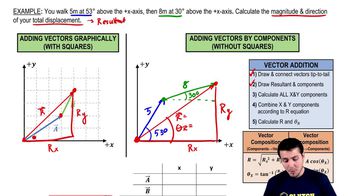
Vector Addition By Components

Trigonometry in Physics

Trigonometry is used to relate the angles and sides of triangles, which is essential in physics for resolving vectors. The sine and cosine functions help determine the components of a vector given its angle with respect to an axis. In this problem, the cosine of the angle can be used to find the x-component, while the sine can verify the y-component.
Recommended video:
Guided course
3:26
Trigonometry

Magnitude of a Vector

The magnitude of a vector is a measure of its length or size, calculated using the Pythagorean theorem for its components. For a vector with components Ax and Ay, the magnitude is √(Ax² + Ay²). This concept is fundamental in physics to understand the overall effect of a vector, such as force or velocity, in a given direction.
Recommended video:
Guided course
03:59
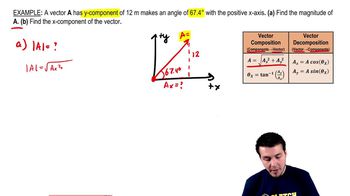
Calculating Magnitude & Components of a Vector