Ch 10: Interactions and Potential Energy
Knight Calc - Physics for Scientists and Engineers 5th Edition
Knight Calc5th EditionPhysics for Scientists and EngineersISBN: 9780137344796Not the one you use?Change textbook
Chapter 10, Problem 34b

A particle moving along the x-axis is in a system that has potential energy U = x3 - 3x J, where x is in m. For each, is it a point of stable or unstable equilibrium?

Verified step by step guidance
1
To determine the points of equilibrium, calculate the derivative of the potential energy function U(x) with respect to x. This gives the force acting on the particle: F(x) = -dU/dx. For equilibrium, the force must be zero, so solve dU/dx = 0.
Differentiate U(x) = x^3 - 3x with respect to x. This gives dU/dx = 3x^2 - 3. Set this equal to zero to find the equilibrium points: 3x^2 - 3 = 0.
Solve the equation 3x^2 - 3 = 0 for x. Factorize or simplify to find the values of x where equilibrium occurs. This will give the equilibrium points.
To determine the stability of each equilibrium point, calculate the second derivative of U(x), d²U/dx². If d²U/dx² > 0 at a point, it is a point of stable equilibrium. If d²U/dx² < 0, it is a point of unstable equilibrium.
Differentiate dU/dx = 3x^2 - 3 again to find d²U/dx². Evaluate d²U/dx² at each equilibrium point found earlier to classify them as stable or unstable.

Verified video answer for a similar problem:

This video solution was recommended by our tutors as helpful for the problem above.
Was this helpful?

Key Concepts

Here are the essential concepts you must grasp in order to answer the question correctly.

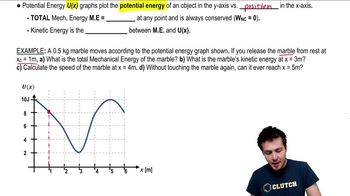
Potential Energy

Potential energy is the energy stored in a system due to its position or configuration. In this case, the potential energy U = x³ - 3x describes how the energy changes as the particle moves along the x-axis. Understanding potential energy is crucial for analyzing the forces acting on the particle and determining its equilibrium points.
Recommended video:
Guided course
07:24
Potential Energy Graphs

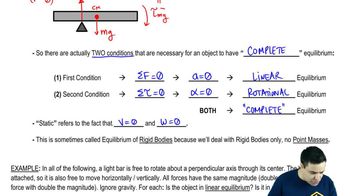
Equilibrium Points

Equilibrium points occur where the net force acting on a particle is zero, meaning the particle is in a state of rest or constant motion. These points can be classified as stable or unstable based on the behavior of the potential energy around them. A stable equilibrium is characterized by a local minimum in potential energy, while an unstable equilibrium corresponds to a local maximum.
Recommended video:
Guided course
10:13
Torque & Equilibrium

Stability Analysis

Stability analysis involves examining the second derivative of the potential energy function to determine the nature of equilibrium points. If the second derivative is positive at a point, it indicates a stable equilibrium, as small displacements will return the particle to equilibrium. Conversely, if the second derivative is negative, the point is unstable, as displacements will lead the particle further away from equilibrium.
Recommended video:
Guided course
05:00
Dimensional Analysis