Ch 12: Rotation of a Rigid Body
Knight Calc - Physics for Scientists and Engineers 5th Edition
Knight Calc5th EditionPhysics for Scientists and EngineersISBN: 9780137344796Not the one you use?Change textbook
Chapter 12, Problem 39

Vector A = 3î+ĵ and vector B= 3î - 2ĵ + 2k. What is the cross product A ✕ B?

Verified step by step guidance
1
Step 1: Recall the formula for the cross product of two vectors. The cross product \( \mathbf{A} \times \mathbf{B} \) is calculated using the determinant of a 3x3 matrix: \( \mathbf{A} \times \mathbf{B} = \begin{vmatrix} \mathbf{i} & \mathbf{j} & \mathbf{k} \\ A_x & A_y & A_z \\ B_x & B_y & B_z \end{vmatrix} \), where \( \mathbf{i}, \mathbf{j}, \mathbf{k} \) are the unit vectors, and \( A_x, A_y, A_z \) and \( B_x, B_y, B_z \) are the components of vectors \( \mathbf{A} \) and \( \mathbf{B} \), respectively.
Step 2: Identify the components of \( \mathbf{A} \) and \( \mathbf{B} \). From the problem, \( \mathbf{A} = 3\mathbf{i} + \mathbf{j} \), so \( A_x = 3, A_y = 1, A_z = 0 \). Similarly, \( \mathbf{B} = 3\mathbf{i} - 2\mathbf{j} + 2\mathbf{k} \), so \( B_x = 3, B_y = -2, B_z = 2 \).
Step 3: Write the determinant for the cross product. Substitute the components into the determinant: \( \mathbf{A} \times \mathbf{B} = \begin{vmatrix} \mathbf{i} & \mathbf{j} & \mathbf{k} \\ 3 & 1 & 0 \\ 3 & -2 & 2 \end{vmatrix} \).
Step 4: Expand the determinant. Use cofactor expansion along the first row: \( \mathbf{A} \times \mathbf{B} = \mathbf{i} \begin{vmatrix} 1 & 0 \\ -2 & 2 \end{vmatrix} - \mathbf{j} \begin{vmatrix} 3 & 0 \\ 3 & 2 \end{vmatrix} + \mathbf{k} \begin{vmatrix} 3 & 1 \\ 3 & -2 \end{vmatrix} \).
Step 5: Compute the 2x2 determinants. For each term: \( \begin{vmatrix} 1 & 0 \\ -2 & 2 \end{vmatrix} = (1)(2) - (0)(-2) = 2 \), \( \begin{vmatrix} 3 & 0 \\ 3 & 2 \end{vmatrix} = (3)(2) - (0)(3) = 6 \), and \( \begin{vmatrix} 3 & 1 \\ 3 & -2 \end{vmatrix} = (3)(-2) - (1)(3) = -9 \). Substitute these into the expression to find the cross product.

Verified video answer for a similar problem:

This video solution was recommended by our tutors as helpful for the problem above.
Video duration:
4m
Was this helpful?

Key Concepts

Here are the essential concepts you must grasp in order to answer the question correctly.

Vector Operations

Vector operations involve mathematical manipulations of vectors, including addition, subtraction, and multiplication. The cross product is a specific operation that takes two vectors and produces a third vector that is perpendicular to the plane formed by the original vectors. Understanding how to perform these operations is essential for solving problems involving vectors.
Recommended video:
Guided course
08:22
Operations with Significant Figures

Cross Product

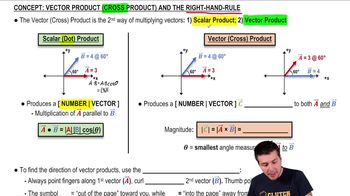
The cross product of two vectors A and B, denoted as A × B, results in a vector that is orthogonal to both A and B. The magnitude of the cross product is given by |A||B|sin(θ), where θ is the angle between the two vectors. The direction of the resulting vector is determined by the right-hand rule, which is crucial for visualizing the orientation of the cross product.
Recommended video:
Guided course
10:30
Vector (Cross) Product and the Right-Hand-Rule

Coordinate System

In physics, vectors are often represented in a three-dimensional Cartesian coordinate system, defined by the unit vectors î, ĵ, and k. Each vector can be expressed in terms of its components along these axes. Understanding how to manipulate vectors in this coordinate system is vital for calculating operations like the cross product, as it allows for clear representation and computation of vector components.
Recommended video:
Guided course
05:17
Coordinates of Center of Mass of 4 objects