Ch 12: Rotation of a Rigid Body
Knight Calc - Physics for Scientists and Engineers 5th Edition
Knight Calc5th EditionPhysics for Scientists and EngineersISBN: 9780137344796Not the one you use?Change textbook
Chapter 12, Problem 37

Evaluate the cross products and A ✕ B and C ✕ D.

Verified step by step guidance
1
Step 1: Understand the cross product formula. The magnitude of the cross product of two vectors A and B is given by |A ✕ B| = |A| |B| sin(θ), where |A| and |B| are the magnitudes of the vectors and θ is the angle between them. The direction of the cross product is perpendicular to the plane containing A and B, determined by the right-hand rule.
Step 2: Analyze the image. The vectors F and E are shown with magnitudes 4 and 3, respectively, and the angle between them is 30°. This information will be used to calculate the magnitude of the cross product.
Step 3: Calculate the magnitude of F ✕ E. Using the formula |F ✕ E| = |F| |E| sin(θ), substitute the values: |F| = 4, |E| = 3, and θ = 30°. The sine of 30° is 0.5.
Step 4: Determine the direction of F ✕ E. Use the right-hand rule: point your fingers in the direction of F, curl them toward E, and your thumb will point in the direction of the cross product vector.
Step 5: Repeat the process for vectors C and D if their magnitudes and angle are provided. Apply the same formula and right-hand rule to evaluate C ✕ D.

Verified video answer for a similar problem:

This video solution was recommended by our tutors as helpful for the problem above.
Video duration:
1m
Was this helpful?

Key Concepts

Here are the essential concepts you must grasp in order to answer the question correctly.

Cross Product

The cross product of two vectors results in a third vector that is perpendicular to the plane formed by the original vectors. It is calculated using the formula A × B = |A||B|sin(θ)n, where θ is the angle between the vectors and n is the unit vector perpendicular to the plane. The magnitude of the cross product represents the area of the parallelogram formed by the two vectors.
Recommended video:
Guided course
10:30
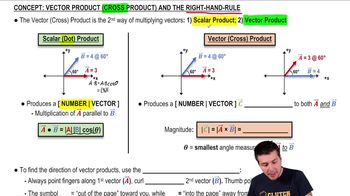
Vector (Cross) Product and the Right-Hand-Rule

Vector Magnitude

The magnitude of a vector is a measure of its length and is calculated using the Pythagorean theorem for two-dimensional vectors. For a vector represented as A = (Ax, Ay), the magnitude is given by |A| = √(Ax² + Ay²). In the context of the question, the magnitudes of vectors E and F are 3 and 4, respectively, which are essential for calculating their cross product.
Recommended video:
Guided course
03:59
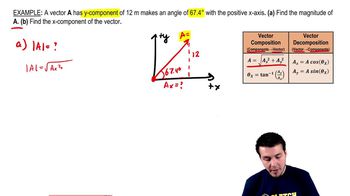
Calculating Magnitude & Components of a Vector

Angle Between Vectors

The angle between two vectors is crucial for determining the sine component in the cross product calculation. In this case, the angle is given as 30°, which affects the magnitude of the resulting vector from the cross product. Understanding how to find and use this angle is key to solving problems involving vector operations.
Recommended video:
Guided course
05:56
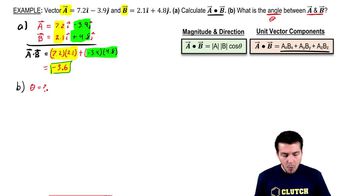
Calculating the Angle Between 2 Vectors Using the Dot Product