Ch 06: Dynamics I: Motion Along a Line
Knight Calc - Physics for Scientists and Engineers 5th Edition
Knight Calc5th EditionPhysics for Scientists and EngineersISBN: 9780137344796Not the one you use?Change textbook
Chapter 6, Problem 50

A baggage handler drops your 10 kg suitcase onto a conveyor belt running at 2.0 m/s. The materials are such that μs = 0.50 and μk = 0.30. How far is your suitcase dragged before it is riding smoothly on the belt?

Verified step by step guidance
1
Step 1: Identify the forces acting on the suitcase. The forces include the gravitational force (weight), the normal force, the static friction force, and the kinetic friction force. The gravitational force is given by \( F_g = m \cdot g \), where \( m = 10 \, \text{kg} \) and \( g = 9.8 \, \text{m/s}^2 \). The normal force is equal in magnitude to the gravitational force since the suitcase is on a horizontal surface.
Step 2: Determine the maximum static friction force using \( F_{\text{static}} = \mu_s \cdot F_N \), where \( \mu_s = 0.50 \) and \( F_N = F_g \). If the force required to accelerate the suitcase exceeds this value, the suitcase will transition to kinetic friction.
Step 3: Calculate the kinetic friction force using \( F_{\text{kinetic}} = \mu_k \cdot F_N \), where \( \mu_k = 0.30 \). This force will oppose the motion of the suitcase as it is dragged by the conveyor belt.
Step 4: Use Newton's second law \( F = m \cdot a \) to find the acceleration of the suitcase while it is under the influence of kinetic friction. The net force acting on the suitcase is \( F_{\text{net}} = F_{\text{kinetic}} \), and \( a = F_{\text{net}} / m \).
Step 5: Apply kinematic equations to determine the distance the suitcase is dragged before it matches the speed of the conveyor belt. Use \( v_f^2 = v_i^2 + 2 \cdot a \cdot d \), where \( v_f = 2.0 \, \text{m/s} \), \( v_i = 0 \, \text{m/s} \), and \( a \) is the acceleration calculated in Step 4. Solve for \( d \), the distance dragged.

Verified video answer for a similar problem:

This video solution was recommended by our tutors as helpful for the problem above.
Video duration:
9m
Was this helpful?

Key Concepts

Here are the essential concepts you must grasp in order to answer the question correctly.

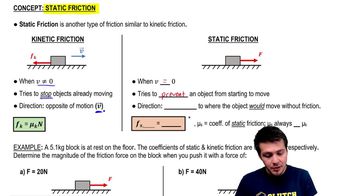
Friction

Friction is the force that opposes the relative motion of two surfaces in contact. It is characterized by two coefficients: static friction (μₛ), which prevents motion, and kinetic friction (μₖ), which acts when surfaces are sliding against each other. In this scenario, the suitcase initially experiences static friction until it starts moving with the conveyor belt.
Recommended video:
Guided course
08:11
Static Friction & Equilibrium

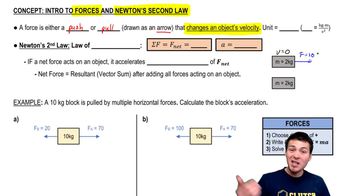
Newton's Second Law of Motion

Newton's Second Law states that the acceleration of an object is directly proportional to the net force acting on it and inversely proportional to its mass (F = ma). This principle is essential for calculating the forces acting on the suitcase as it transitions from rest to moving with the conveyor belt, allowing us to determine how far it is dragged before it matches the belt's speed.
Recommended video:
Guided course
06:54
Intro to Forces & Newton's Second Law

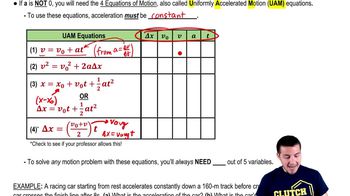
Kinematics

Kinematics is the branch of mechanics that deals with the motion of objects without considering the forces that cause the motion. It involves concepts such as displacement, velocity, and acceleration. In this problem, kinematic equations will be used to calculate the distance the suitcase is dragged before it reaches the same speed as the conveyor belt.
Recommended video:
Guided course
08:25
Kinematics Equations
Related Practice
Textbook Question

The motor of a 350 g model rocket generates 9.5 N thrust. If air resistance can be neglected, what will be the rocket's speed as it reaches a height of 85 m?

1609
views

Textbook Question

Sam, whose mass is 75 kg, takes off across level snow on his jet-powered skis. The skis have a thrust of 200 N and a coefficient of kinetic friction on snow of 0.10. Unfortunately, the skis run out of fuel after only 10 s. What is Sam's top speed?

2488
views
Textbook Question

A 1.0 kg wood block is pressed against a vertical wood wall by the 12 N force shown in FIGURE P6.57. If the block is initially at rest, will it move upward, move downward, or stay at rest?

2095
views
Textbook Question

A 5.0 kg wooden sled is launched up a 25° snow-covered slope with an initial speed of 10 m/s. What vertical height does the sled reach above its starting point?

2758
views
6
rank
Textbook Question

A large box of mass M is moving on a horizontal surface at speed v₀. A small box of mass m sits on top of the large box. The coefficients of static and kinetic friction between the two boxes are μs and μk, respectively. Find an expression for the shortest distance dmin in which the large box can stop without the small box slipping.

1848
views
Textbook Question

Sam, whose mass is 75 kg, takes off across level snow on his jet-powered skis. The skis have a thrust of 200 N and a coefficient of kinetic friction on snow of 0.10. Unfortunately, the skis run out of fuel after only 10 s. How far has Sam traveled when he finally coasts to a stop?

589
views