An electric dipole at the origin consists of two charges ±q spaced distance s apart along the y-axis. What is the field Ē on the bisecting axis? Does your result agree with Equation 23.11?
Ch 26: Potential and Field
Knight Calc5th EditionPhysics for Scientists and EngineersISBN: 9780137344796Not the one you use?Change textbook
Chapter 26, Problem 81a
Find an expression for the capacitance of a spherical capacitor, consisting of concentric spherical shells of radii R1 (inner shell) and R2 (outer shell).
Verified step by step guidance1
Start by recalling the formula for the capacitance of a capacitor: \( C = \frac{Q}{\Delta V} \), where \( Q \) is the charge on the capacitor and \( \Delta V \) is the potential difference between the two shells.
Determine the electric field \( E \) between the two spherical shells using Gauss's law: \( \oint \mathbf{E} \cdot d\mathbf{A} = \frac{Q}{\varepsilon_0} \). For a spherical shell, the electric field at a distance \( r \) from the center is \( E = \frac{Q}{4 \pi \varepsilon_0 r^2} \).
Find the potential difference \( \Delta V \) between the two shells by integrating the electric field from \( R_1 \) to \( R_2 \): \( \Delta V = \int_{R_1}^{R_2} E \, dr = \int_{R_1}^{R_2} \frac{Q}{4 \pi \varepsilon_0 r^2} \, dr \). Perform the integration to get \( \Delta V = \frac{Q}{4 \pi \varepsilon_0} \left( \frac{1}{R_1} - \frac{1}{R_2} \right) \).
Substitute \( \Delta V \) into the capacitance formula \( C = \frac{Q}{\Delta V} \): \( C = \frac{Q}{\frac{Q}{4 \pi \varepsilon_0} \left( \frac{1}{R_1} - \frac{1}{R_2} \right)} \). Simplify the expression to get \( C = 4 \pi \varepsilon_0 \left( \frac{1}{\frac{1}{R_1} - \frac{1}{R_2}} \right) \).
Simplify further to express the capacitance in terms of \( R_1 \) and \( R_2 \): \( C = \frac{4 \pi \varepsilon_0 R_1 R_2}{R_2 - R_1} \). This is the final expression for the capacitance of the spherical capacitor.

Verified video answer for a similar problem:
This video solution was recommended by our tutors as helpful for the problem above.
Was this helpful?
Key Concepts
Here are the essential concepts you must grasp in order to answer the question correctly.
Capacitance
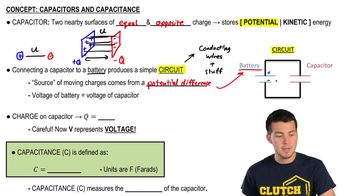
Capacitance is a measure of a capacitor's ability to store charge per unit voltage. It is defined as the ratio of the electric charge (Q) stored on one conductor to the potential difference (V) between the conductors. The unit of capacitance is the farad (F), where 1 farad equals 1 coulomb per volt.
Recommended video:
Guided course
Capacitors & Capacitance (Intro)
Electric Field
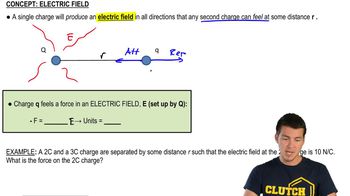
The electric field (E) is a vector field that represents the force per unit charge experienced by a positive test charge placed in the field. For a spherical capacitor, the electric field between the two shells can be derived from Gauss's law, which relates the electric field to the charge enclosed by a Gaussian surface. The electric field is crucial for understanding how the capacitor stores energy.
Recommended video:
Guided course
Intro to Electric Fields
Gauss's Law
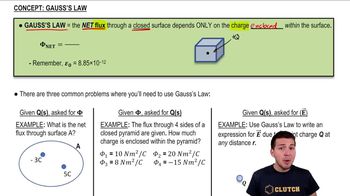
Gauss's Law states that the electric flux through a closed surface is proportional to the charge enclosed within that surface. It is mathematically expressed as ∮E·dA = Q_enc/ε₀, where E is the electric field, dA is the differential area, Q_enc is the enclosed charge, and ε₀ is the permittivity of free space. This law is essential for deriving the electric field in spherical capacitors and ultimately calculating their capacitance.
Recommended video:
Guided course
Gauss' Law
Related Practice
Textbook Question
125
views
Textbook Question
Consider a uniformly charged sphere of radius R and total charge Q. The electric field Eout outside the sphere (r≥R) is simply that of a point charge Q. In Chapter 24, we used Gauss’s law to find that the electric field Ein inside the sphere (r≤R) is radially outward with field strength . What is the ratio Vcenter/Vsurface?
1930
views
Textbook Question
Charge is uniformly distributed with charge density ρ inside a very long cylinder of radius R. Find the potential difference between the surface and the axis of the cylinder.
112
views
Textbook Question
Each capacitor in FIGURE CP26.83 has capacitance C. What is the equivalent capacitance between points a and b?
234
views
Textbook Question
A spherical capacitor with a 1.0 mm gap between the shells has a capacitance of 100 pF. What are the diameters of the two spheres?
78
views