Ch 32: AC Circuits
Knight Calc - Physics for Scientists and Engineers 5th Edition
Knight Calc5th EditionPhysics for Scientists and EngineersISBN: 9780137344796Not the one you use?Change textbook
Chapter 32, Problem 45

A series RC circuit is built with a 12 kΩ resistor and a parallel-plate capacitor with 15-cm-diameter electrodes. A 12 V, 36 kHz source drives a peak current of 0.65 mA through the circuit. What is the spacing between the capacitor plates?

Verified step by step guidance
1
Step 1: Identify the key components of the problem. The circuit consists of a resistor (R = 12 kΩ), a capacitor with parallel-plate electrodes (diameter = 15 cm), a voltage source (V = 12 V), and a frequency (f = 36 kHz). The peak current (I₀ = 0.65 mA) is also given. The goal is to find the spacing (d) between the capacitor plates.
Step 2: Calculate the capacitive reactance (Xₐ) using the formula for the impedance of an RC circuit. The relationship between the peak current and voltage is given by Ohm's law: \( Xₐ = \frac{V}{I₀} \). Substitute the given values for V and I₀ to find \( Xₐ \).
Step 3: Relate the capacitive reactance to the capacitance (C) using the formula \( Xₐ = \frac{1}{2 \pi f C} \). Rearrange this equation to solve for \( C \): \( C = \frac{1}{2 \pi f Xₐ} \). Substitute the values for frequency (f) and \( Xₐ \) to calculate \( C \).
Step 4: Use the formula for the capacitance of a parallel-plate capacitor: \( C = \frac{\varepsilon_0 A}{d} \), where \( \varepsilon_0 \) is the permittivity of free space (\( \varepsilon_0 = 8.85 \times 10^{-12} \, \text{F/m} \)), \( A \) is the area of the plates, and \( d \) is the spacing between the plates. Calculate the area \( A \) using \( A = \pi r^2 \), where \( r \) is the radius of the plates (half the diameter).
Step 5: Rearrange the formula \( C = \frac{\varepsilon_0 A}{d} \) to solve for \( d \): \( d = \frac{\varepsilon_0 A}{C} \). Substitute the values for \( \varepsilon_0 \), \( A \), and \( C \) to find the spacing \( d \) between the plates.

Verified video answer for a similar problem:

This video solution was recommended by our tutors as helpful for the problem above.
Was this helpful?

Key Concepts

Here are the essential concepts you must grasp in order to answer the question correctly.

RC Circuit

An RC circuit consists of a resistor (R) and a capacitor (C) connected in series or parallel. The behavior of the circuit is characterized by its time constant, τ = RC, which determines how quickly the capacitor charges and discharges. In this question, the RC circuit's response to an alternating current (AC) source is crucial for understanding the relationship between voltage, current, and capacitance.
Recommended video:
Guided course
03:45
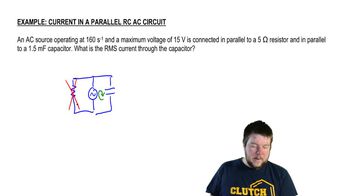
Current in a Parallel RC AC Circuit

Capacitance

Capacitance is the ability of a capacitor to store charge per unit voltage, defined as C = Q/V, where Q is the charge and V is the voltage across the capacitor. The capacitance of a parallel-plate capacitor is given by C = ε₀(A/d), where ε₀ is the permittivity of free space, A is the area of the plates, and d is the distance between them. This relationship is essential for calculating the spacing between the capacitor plates in the given circuit.
Recommended video:
Guided course
08:02
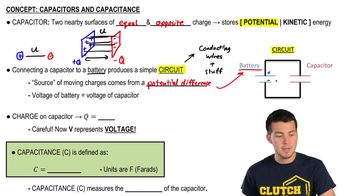
Capacitors & Capacitance (Intro)

Impedance in AC Circuits

In AC circuits, impedance (Z) combines resistance (R) and reactance (X) to determine how much the circuit opposes the flow of alternating current. For an RC circuit, the impedance is given by Z = √(R² + (1/(2πfC))²), where f is the frequency of the AC source. Understanding impedance is vital for analyzing how the circuit responds to the 36 kHz source and how it affects the current and voltage across the capacitor.
Recommended video:
Guided course
08:40
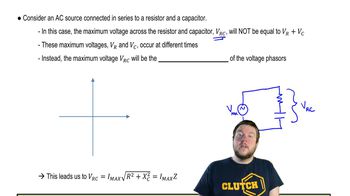
Impedance in AC Circuits