Ch 32: AC Circuits
Knight Calc - Physics for Scientists and Engineers 5th Edition
Knight Calc5th EditionPhysics for Scientists and EngineersISBN: 9780137344796Not the one you use?Change textbook
Chapter 32, Problem 43a

For an RC circuit, find an expression for the angular frequency at which VR = ½ ε0.

Verified step by step guidance
1
Step 1: Begin by understanding the relationship between the voltage across the resistor (Vᵣ) and the total voltage (ε₀) in an RC circuit. The voltage across the resistor is given by Vᵣ = I * R, where I is the current and R is the resistance.
Step 2: Recall that in an RC circuit, the current I is related to the angular frequency ω by the impedance Z. The impedance Z is given by Z = √(R² + (1/(ωC))²), where C is the capacitance.
Step 3: Use Ohm's Law to express the voltage across the resistor as Vᵣ = ε₀ * (R / Z). Substitute Z = √(R² + (1/(ωC))²) into this expression.
Step 4: Set Vᵣ = ½ ε₀ as given in the problem. This leads to the equation ½ ε₀ = ε₀ * (R / √(R² + (1/(ωC))²)). Simplify this equation to isolate ω.
Step 5: Solve for ω by squaring both sides and rearranging terms. You will arrive at an expression for the angular frequency ω in terms of R and C. The final expression should look like ω = 1 / (R√3C).

Verified video answer for a similar problem:

This video solution was recommended by our tutors as helpful for the problem above.
Was this helpful?

Key Concepts

Here are the essential concepts you must grasp in order to answer the question correctly.

RC Circuit

An RC circuit consists of a resistor (R) and a capacitor (C) connected in series or parallel. The behavior of the circuit is characterized by the charging and discharging of the capacitor through the resistor, which affects the voltage across the capacitor over time. Understanding the time constant, τ = RC, is crucial as it determines how quickly the capacitor charges to a certain voltage.
Recommended video:
Guided course
03:45
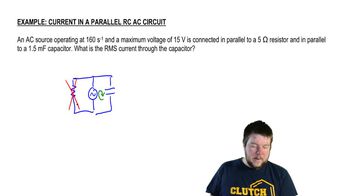
Current in a Parallel RC AC Circuit

Angular Frequency

Angular frequency, denoted by ω, is a measure of how quickly an oscillating system cycles through its phases, expressed in radians per second. In the context of an RC circuit, it relates to the frequency of the voltage or current oscillations when the circuit is subjected to alternating current (AC). The relationship between angular frequency and frequency (f) is given by ω = 2πf.
Recommended video:
Guided course
05:08
Circumference, Period, and Frequency in UCM

Voltage Divider Rule

The voltage divider rule is a fundamental principle used to determine the voltage across a particular component in a series circuit. In an RC circuit, this rule can be applied to find the voltage across the resistor or capacitor when a voltage source is applied. For the given condition Vᵣ = ½ ε₀, this rule helps in deriving the expression for angular frequency by relating the voltages across the components to the total voltage.
Recommended video:
Guided course
04:08
Kirchhoff's Junction Rule