
Ch 18: A Macroscopic Description of Matter
Knight Calc - Physics for Scientists and Engineers 5th Edition
Knight Calc5th EditionPhysics for Scientists and EngineersISBN: 9780137344796Not the one you use?Change textbook
Chapter 18, Problem 44a

The semiconductor industry manufactures integrated circuits in large vacuum chambers where the pressure is 1.0×10⁻¹⁰ mm of Hg. What fraction is this of atmospheric pressure?

Verified step by step guidance
1
Convert the given pressure in the vacuum chamber from mm of Hg to Pascals (Pa) using the conversion factor: 1 mm of Hg = 133.322 Pa. The pressure in the vacuum chamber is \( P_{vacuum} = 1.0 \times 10^{-10} \times 133.322 \) Pa.
Determine the atmospheric pressure in Pascals. Standard atmospheric pressure is \( P_{atm} = 101325 \) Pa.
Calculate the fraction of the vacuum chamber pressure to atmospheric pressure using the formula: \( \text{Fraction} = \frac{P_{vacuum}}{P_{atm}} \).
Substitute the values of \( P_{vacuum} \) and \( P_{atm} \) into the formula to compute the fraction.
Express the result as a dimensionless number, which represents the fraction of the vacuum chamber pressure relative to atmospheric pressure.

Verified video answer for a similar problem:

This video solution was recommended by our tutors as helpful for the problem above.
Video duration:
2m
Was this helpful?

Key Concepts

Here are the essential concepts you must grasp in order to answer the question correctly.

Atmospheric Pressure

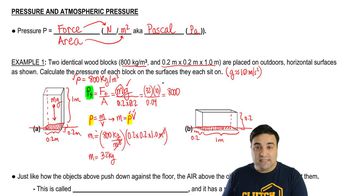
Atmospheric pressure is the force exerted by the weight of air above a given point, typically measured at sea level as approximately 1013.25 hPa (hectopascals) or 760 mm of Hg (millimeters of mercury). Understanding this baseline pressure is crucial for comparing other pressures, such as those found in vacuum chambers.
Recommended video:
Guided course
17:04
Pressure and Atmospheric Pressure

Vacuum Pressure

Vacuum pressure refers to the pressure in a system that is lower than atmospheric pressure. It is often expressed in terms of mm of Hg or torr, where a perfect vacuum is 0 mm of Hg. In the context of the semiconductor industry, achieving a high vacuum (like 1.0×10^−10 mm of Hg) is essential for processes like deposition and etching, which require minimal contamination.
Recommended video:
Guided course
17:04
Pressure and Atmospheric Pressure

Pressure Ratio Calculation

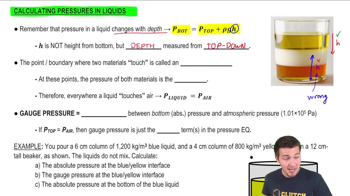
Calculating the fraction of a given pressure relative to atmospheric pressure involves dividing the pressure in question by the standard atmospheric pressure. This ratio helps quantify how much lower the vacuum pressure is compared to normal conditions, providing insight into the effectiveness of the vacuum system used in manufacturing processes.
Recommended video:
Guided course
13:11
Calculating Pressure in Liquids
Related Practice
Textbook Question

A 6.0-cm-diameter, 10-cm-long cylinder contains 100 mg of oxygen (O₂) at a pressure less than 1 atm. The cap on one end of the cylinder is held in place only by the pressure of the air. One day when the atmospheric pressure is 100 kPa, it takes a 184 N force to pull the cap off. What is the temperature of the gas?

1598
views
Textbook Question

The semiconductor industry manufactures integrated circuits in large vacuum chambers where the pressure is 1.0×10⁻¹⁰ mm of Hg. At T=20°C, how many molecules are in a cylindrical chamber 40 cm in diameter and 30 cm tall?

1730
views
Textbook Question

The 828-m-tall Burj Khalifa in Dubai is the world's tallest building. It's essentially a steel building wrapped in exterior paneling and glass. During construction, when the beams were exposed to the elements, the building was 36 cm taller on the hottest afternoon of the year than on the coldest morning. By how much did the temperature vary throughout the year?

2342
views
Textbook Question

On average, each person in the industrialized world is responsible for the emission of 10,000 kg of carbon dioxide (CO₂) every year. This includes CO₂ that you generate directly, by burning fossil fuels to operate your car or your furnace, as well as CO₂ generated on your behalf by electric generating stations and manufacturing plants. CO₂ is a greenhouse gas that contributes to global warming. If you were to store your yearly CO₂ emissions in a cube at STP, how long would each edge of the cube be?

1497
views
Textbook Question

The molecular mass of water (H₂O) is 18 u. How many protons are there in 1.0 L of liquid water?

2915
views
Textbook Question

A sealed container holds 3.2 g of oxygen at 1 atm pressure and 20°C. The gas first undergoes an isobaric process that doubles the absolute temperature, then an isothermal process that halves the pressure. What is the final volume of the gas in L?

2423
views