

Ch 19: Work, Heat, and the First Law of Thermodynamics
Knight Calc - Physics for Scientists and Engineers 5th Edition
Knight Calc5th EditionPhysics for Scientists and EngineersISBN: 9780137344796Not the one you use?Change textbook
Chapter 19, Problem 75a

In Problems 75, 76, and 77 you are given the equation used to solve a problem. For each of these, you are to write a realistic problem for which this is the correct equation.
50J=n(8.31J/mol K)(350K)ln(13)(200×106m3)(13,600kg/m3)50\,\(\text{J}\)=-n(8.31\,\(\text{J/mol K}\))(350\,\(\text{K}\))\(\ln\]\left\)(\(\frac\)13\(\right\))(200\(\times\)10^{-6}\,\(\text{m}\)^3)(13,600\,\(\text{kg/m}\)^3)

Verified step by step guidance
1
Step 1: Analyze the given equation and identify the physical quantities involved. The equation includes terms such as energy (Joules), number of moles (n), gas constant (R = 8.31 J/mol·K), temperature (T = 350 K), natural logarithm (ln), volume (m³), and density (kg/m³). This suggests the problem is related to thermodynamics and possibly involves entropy or work done in a system.
Step 2: Recognize the logarithmic term ln(1/3). This indicates a ratio or change in a quantity, such as volume or pressure, which is common in processes like gas expansion or compression. The negative sign suggests a decrease in entropy or work done by the system.
Step 3: Consider the context of the equation. The presence of the gas constant and temperature implies the involvement of an ideal gas. The volume and density terms might relate to the properties of a substance undergoing a phase change or compression.
Step 4: Formulate a realistic scenario. For example, the problem could describe a gas undergoing isothermal compression where the work done is calculated using the given equation. Alternatively, it could involve a liquid being compressed, with the density and volume terms representing the properties of the liquid.
Step 5: Write the problem statement. For instance: 'A gas is compressed isothermally at a temperature of 350 K. The initial volume is 200 × 10⁻⁶ m³, and the density of the gas is 13,600 kg/m³. Calculate the work done during the compression process, given that the final volume is one-third of the initial volume.'

Verified video answer for a similar problem:

This video solution was recommended by our tutors as helpful for the problem above.
Was this helpful?

Key Concepts

Here are the essential concepts you must grasp in order to answer the question correctly.

Ideal Gas Law

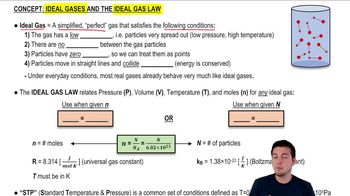
The Ideal Gas Law relates the pressure, volume, temperature, and number of moles of an ideal gas through the equation PV = nRT. In this context, the equation provided involves thermodynamic principles that can be applied to gases, where R is the universal gas constant. Understanding this law is crucial for formulating problems involving gas behavior under varying conditions.
Recommended video:
Guided course
07:21
Ideal Gases and the Ideal Gas Law

Thermodynamic Processes

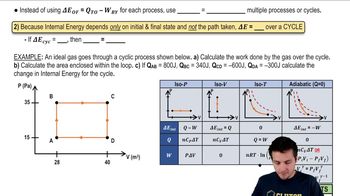
Thermodynamic processes describe how energy is transferred and transformed in a system. The equation given suggests a process involving heat transfer and work done, which are key components in thermodynamics. Recognizing the type of process (isothermal, adiabatic, etc.) is essential for creating realistic problems that align with the equation.
Recommended video:
Guided course
08:45
Properties of Cyclic Thermodynamic Processes

Natural Logarithm in Thermodynamics

The natural logarithm appears frequently in thermodynamic equations, particularly in calculations involving entropy and the change in state variables. In the provided equation, ln(1/3) indicates a relationship between the state of the system and its entropy change. Understanding how to manipulate logarithmic functions is vital for solving problems that involve exponential relationships in thermodynamics.
Recommended video:
10:30
Ray Nature of Light
Related Practice
Textbook Question

Most stars are main-sequence stars, a group of stars for which size, mass, surface temperature, and radiated power are closely related. The sun, for instance, is a yellow main-sequence star with a surface temperature of 5800 K. For a main-sequence star whose mass M is more than twice that of the sun, the total radiated power, relative to the sun, is approximately P/Psun=1.5(M/Msun)3.5. The star Regulus A is a bluish main-sequence star with mass 3.8Msun and radius 3.1Rsun. What is the surface temperature of Regulus A?

1671
views
Textbook Question

One cylinder in the diesel engine of a truck has an initial volume of 600 cm3. Air is admitted to the cylinder at 30°C and a pressure of 1.0 atm. The piston rod then does 400 J of work to rapidly compress the air. What are its final temperature and volume?

983
views
Textbook Question

FIGURE CP19.80 shows a thermodynamic process followed by 0.015 mol of hydrogen. How much heat energy is transferred to the gas?

1441
views
Textbook Question

10 g of aluminum at 200°C and 20 g of copper are dropped into 50 cm3 of ethyl alcohol at 15°C. The temperature quickly comes to 25°C. What was the initial temperature of the copper?

1652
views
Textbook Question

A lava flow is threatening to engulf a small town. A 400-m-wide, 35-cm-thick tongue of 1200°C lava is advancing at the rate of 1.0 m per minute. The mayor devises a plan to stop the lava in its tracks by flying in large quantities of 20°C water and dousing it. The lava has density 2500 kg/m3, specific heat 1100 J/kg K, melting temperature 800°C, and heat of fusion 4.0×10⁵ J/kg. How many liters of water per minute, at a minimum, will be needed to save the town?

1180
views
Textbook Question

A flow-through electric water heater has a 20 kW electric heater inside an insulated 2.0-cm-diameter pipe so that water flowing through the pipe will have good thermal contact with the heater. Assume that all the heat energy is transferred to the water. Suppose the inlet water temperature is 12°C and the flow rate is 8.0 L/min (about that of a standard shower head). What is the outlet temperature?

1456
views