

Ch 19: Work, Heat, and the First Law of Thermodynamics
Knight Calc - Physics for Scientists and Engineers 5th Edition
Knight Calc5th EditionPhysics for Scientists and EngineersISBN: 9780137344796Not the one you use?Change textbook
Chapter 19, Problem 72

Most stars are main-sequence stars, a group of stars for which size, mass, surface temperature, and radiated power are closely related. The sun, for instance, is a yellow main-sequence star with a surface temperature of 5800 K. For a main-sequence star whose mass M is more than twice that of the sun, the total radiated power, relative to the sun, is approximately P/Psun=1.5(M/Msun)3.5. The star Regulus A is a bluish main-sequence star with mass 3.8Msun and radius 3.1Rsun. What is the surface temperature of Regulus A?

Verified step by step guidance
1
Step 1: Begin by understanding the Stefan-Boltzmann law, which relates the radiated power of a star to its surface temperature. The formula is P = σA(T^4), where P is the radiated power, σ is the Stefan-Boltzmann constant, A is the surface area of the star, and T is the surface temperature.
Step 2: Calculate the surface area of Regulus A using the formula for the surface area of a sphere, A = 4πR². Since the radius of Regulus A is given as 3.1Rₛᵤₙ, substitute this value into the formula to express the surface area in terms of the sun's radius.
Step 3: Use the given relationship for radiated power relative to the sun, P/Pₛᵤₙ = 1.5(M/Mₛᵤₙ)^3.5, to calculate the radiated power of Regulus A relative to the sun. Substitute the mass of Regulus A (3.8Mₛᵤₙ) into the formula.
Step 4: Combine the Stefan-Boltzmann law and the relative power formula. Express the surface temperature of Regulus A in terms of the sun's surface temperature (Tₛᵤₙ). Use the relationship T = (P / (σA))^(1/4) and substitute the values for P and A calculated in the previous steps.
Step 5: Simplify the expression for the surface temperature of Regulus A, ensuring all terms are expressed relative to the sun's values (Tₛᵤₙ, Rₛᵤₙ, etc.). This will give the surface temperature of Regulus A in terms of Tₛᵤₙ.

Verified video answer for a similar problem:

This video solution was recommended by our tutors as helpful for the problem above.
Video duration:
7m
Was this helpful?

Key Concepts

Here are the essential concepts you must grasp in order to answer the question correctly.

Main-Sequence Stars

Main-sequence stars are a category of stars that are in a stable phase of stellar evolution, where they fuse hydrogen into helium in their cores. Their properties, such as size, mass, surface temperature, and luminosity, are interrelated, following specific relationships defined by stellar models. The sun is a prime example of a main-sequence star, and understanding this category is crucial for analyzing other stars' characteristics.
Recommended video:
Guided course
06:36
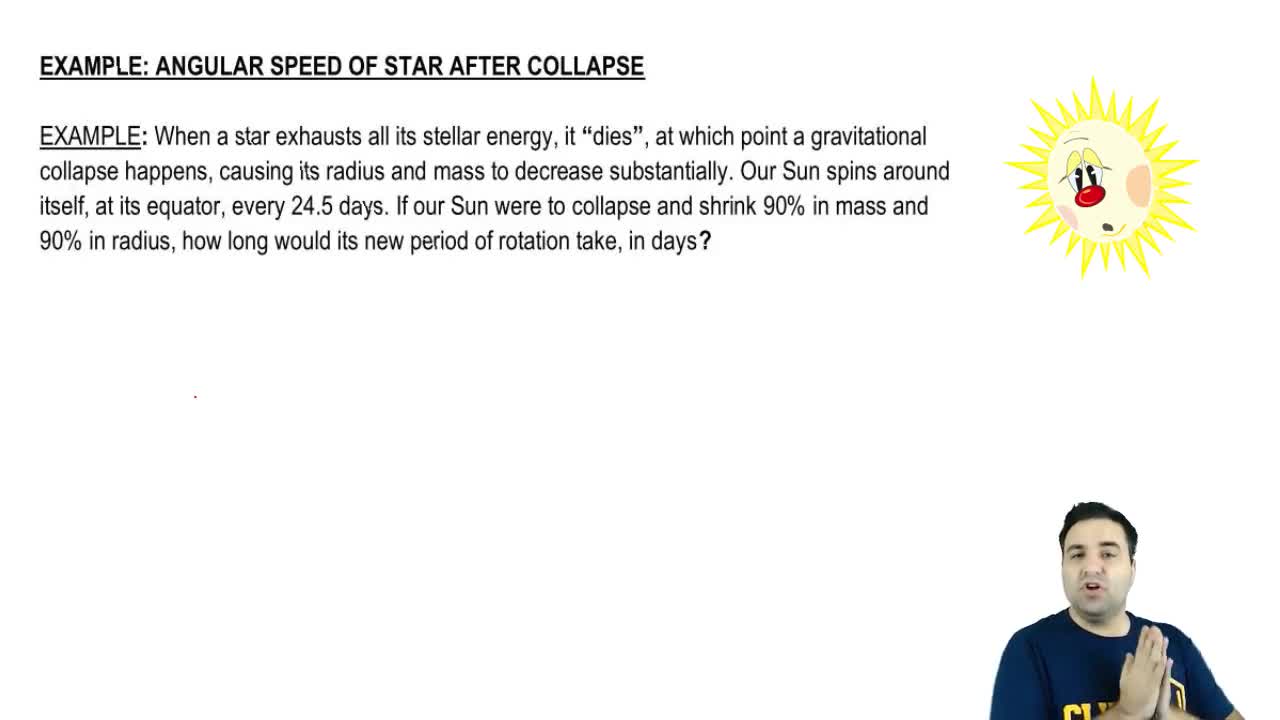
Star collapses

Stellar Mass-Luminosity Relation

The mass-luminosity relation describes how the luminosity (or total radiated power) of a star is related to its mass. For main-sequence stars, this relationship can be expressed as P/Pₛᵤₙ = (M/Mₛᵤₙ)³.⁵, indicating that more massive stars emit significantly more energy. This concept is essential for calculating the luminosity of stars like Regulus A based on its mass.
Recommended video:
Guided course
20:32
Mass Spectrometers

Surface Temperature and Color

The surface temperature of a star is a critical factor that influences its color and spectral classification. Higher temperatures correspond to bluer stars, while lower temperatures correspond to redder stars. The temperature can be estimated using the Stefan-Boltzmann law, which relates luminosity, radius, and temperature, allowing for the determination of a star's surface temperature based on its luminosity and size.
Recommended video:
Guided course
09:18
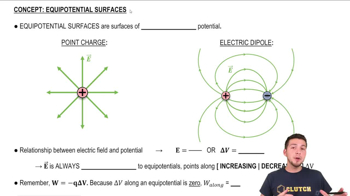
Equipotential Surfaces
Related Practice
Textbook Question

14 g of nitrogen gas at STP are pressurized in an isochoric process to a pressure of 20 atm. What are the final temperature?

732
views
Textbook Question

A monatomic gas is adiabatically compressed to 1/8 of its initial volume. Does each of the following quantities change? If so, does it increase or decrease, and by what factor? If not, why not? The molar specific heat at constant volume.

342
views
Textbook Question

Liquid helium, with a boiling point of 4.2 K, is used in ultralow-temperature experiments and also for cooling the superconducting magnets used in MRI imaging in medicine. Storing liquid helium so far below room temperature is a challenge because even a small 'heat leak' will boil the helium away. A standard helium dewar, shown in FIGURE P19.67, has an inner stainless-steel cylinder filled with liquid helium surrounded by an outer cylindrical shell filled with liquid nitrogen at –196°C. The space between is a vacuum. The small structural supports have very low thermal conductivity, so you can assume that radiation is the only heat transfer between the helium and its surroundings. Suppose the helium cylinder is 16 cm in diameter and 30 cm tall and that all walls have an emissivity of 0.25. The density of liquid helium is 125 kg/m3 and its heat of vaporization is 2.1×10⁴ J/kg. What is the mass of helium in the filled cylinder?

1190
views
1
rank
Textbook Question

One cylinder in the diesel engine of a truck has an initial volume of 600 cm3. Air is admitted to the cylinder at 30°C and a pressure of 1.0 atm. The piston rod then does 400 J of work to rapidly compress the air. What are its final temperature and volume?

416
views
Textbook Question

A flow-through electric water heater has a 20 kW electric heater inside an insulated 2.0-cm-diameter pipe so that water flowing through the pipe will have good thermal contact with the heater. Assume that all the heat energy is transferred to the water. Suppose the inlet water temperature is 12°C and the flow rate is 8.0 L/min (about that of a standard shower head). What is the outlet temperature?

682
views
Textbook Question

In Problems 75, 76, and 77 you are given the equation used to solve a problem. For each of these, you are to write a realistic problem for which this is the correct equation.

50J=n(8.31J/mol K)(350K)ln(13)(200×106m3)(13,600kg/m3)50\,\text{J}=-n(8.31\,\text{J/mol K})(350\,\text{K})\ln\left(\frac13\right)(200\times10^{-6}\,\text{m}^3)(13,600\,\text{kg/m}^3)

72
views