Ch 04: Kinematics in Two Dimensions
Knight Calc - Physics for Scientists and Engineers 5th Edition
Knight Calc5th EditionPhysics for Scientists and EngineersISBN: 9780137344796Not the one you use?Change textbook
Chapter 4, Problem 74a

A 6.0-cm-diameter gear rotates with angular velocity ω = ( 20 ─ ½ t² ) rad/s where t is in seconds. At t = 4.0 s, what are: The gear's angular acceleration?

Verified step by step guidance
1
Step 1: Recall the formula for angular acceleration, which is the time derivative of angular velocity. Mathematically, angular acceleration (α) is given by: α=dωdt.
Step 2: Differentiate the given angular velocity equation, ω = (20 - ½ t²), with respect to time t. The derivative of ω with respect to t is: dωdt=-12*2t, which simplifies to -t.
Step 3: Substitute t = 4.0 s into the expression for angular acceleration derived in Step 2. This will give the angular acceleration at t = 4.0 s.
Step 4: Interpret the result. Since the angular acceleration is negative, it indicates that the gear is slowing down at t = 4.0 s.
Step 5: Ensure units are consistent. Angular acceleration is measured in rad/s², so verify that the final value has the correct units.

Verified video answer for a similar problem:

This video solution was recommended by our tutors as helpful for the problem above.
Video duration:
4m
Was this helpful?

Key Concepts

Here are the essential concepts you must grasp in order to answer the question correctly.

Angular Velocity

Angular velocity is a measure of how quickly an object rotates around an axis, expressed in radians per second (rad/s). It indicates the rate of change of angular displacement over time. In this question, the angular velocity is given as a function of time, which means it changes as time progresses.
Recommended video:
Guided course
06:18
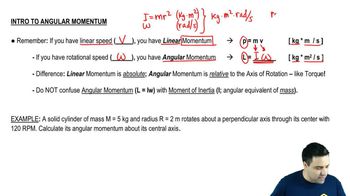
Intro to Angular Momentum

Angular Acceleration

Angular acceleration is the rate of change of angular velocity over time, typically measured in radians per second squared (rad/s²). It can be calculated by taking the derivative of the angular velocity function with respect to time. Understanding angular acceleration is crucial for determining how quickly the gear's rotation is speeding up or slowing down.
Recommended video:
Guided course
12:12
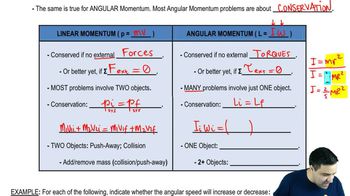
Conservation of Angular Momentum

Differentiation

Differentiation is a fundamental concept in calculus that involves finding the rate at which a quantity changes. In the context of this problem, differentiation is used to calculate angular acceleration by deriving the angular velocity function with respect to time. This process allows us to determine how the gear's rotation changes as time progresses.
Recommended video:
Guided course
13:04
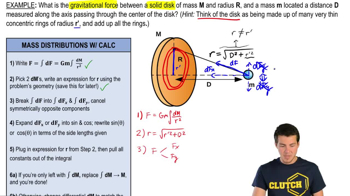
Gravitational Force from a Solid Disk
Related Practice
Textbook Question

In Problems 78, 79, and 80 you are given the equations that are used to solve a problem. For each of these, you are to write a realistic problem for which these are the correct equations. Be sure that the answer your problem requests is consistent with the equations given.

100m=0m+(50cosθm/s)t10m=0m+(50sinθm/s)t112(9.80m/s2)t12\(\begin{aligned}\)100 \, \(\text{m}\) &= 0 \, \(\text{m}\) + (50 \(\cos\) \(\theta\) \, \(\text{m/s}\)) t_1 \\0 \, \(\text{m}\) &= 0 \, \(\text{m}\) + (50 \(\sin\) \(\theta\) \, \(\text{m/s}\)) t_1 - \(\frac{1}{2}\) (9.80 \, \(\text{m/s}\)^2) t_1^2\(\end{aligned}\)

422
views
Textbook Question

A 25 g steel ball is attached to the top of a 24-cm-diameter vertical wheel. Starting from rest, the wheel accelerates at 470 rad/s². The ball is released after ¾ of a revolution. How high does it go above the center of the wheel?

2111
views
Textbook Question

A 6.0-cm-diameter gear rotates with angular velocity ω = ( 20 ─ ½ t² ) rad/s where t is in seconds. At t = 4.0 s, what are: The tangential acceleration of a tooth on the gear?

1489
views
Textbook Question

A painted tooth on a spinning gear has angular position θ = (6.0 rad/s⁴)t⁴. What is the tooth's angular acceleration at the end of 10 revolutions?

1935
views
Textbook Question

The angular velocity of a process control motor is ω = ( 20 - ½ t² ) rad/s, where t is in seconds. At what time does the motor reverse direction?

1471
views
Textbook Question

The angular velocity of a process control motor is ω = ( 20 ─ ½ t² ) rad/s, where t is in seconds. Through what angle does the motor turn between t = 0 s and the instant at which it reverses direction?

1908
views