Ch 29: The Magnetic Field
Knight Calc - Physics for Scientists and Engineers 5th Edition
Knight Calc5th EditionPhysics for Scientists and EngineersISBN: 9780137344796Not the one you use?Change textbook
Chapter 29, Problem 67

Controlled fusion is a possible future energy source that would harness the same nuclear fusion reactions that power the sun. The simplest fusion reaction is ²H⁺ + ²H⁺ → ³He⁺⁺ + n + energy, in which nuclei of two deuterium atoms fuse into a nucleus while ejecting a neutron and releasing a substantial amount of energy. Deuterium is not an element but is the name given to 'heavy hydrogen,' in which the nucleus is not simply a proton but a proton and a neutron, with atomic mass 2 u. Two positive deuterium nuclei, which repel each other, can get close enough to fuse only if they have very high speeds. This can be achieved by creating a plasma of ionized deuterium gas at a temperature of 1.0 x 10⁸ K. No material substance can contain a plasma at this temperature, so the idea is to contain the plasma with magnetic fields. Consider the simplest model of using a solenoid to confine the ions to cyclotron motion around the field lines. The plasma ions have a range of speeds, and it's necessary to contain all the ions with speeds up to three times the rms speed at the plasma temperature. What magnetic field strength is needed to keep the fastest ions in 20-cm-diameter cyclotron orbits? The actual magnetic fields are considerably more complex, but your answer is a reasonable estimate of the required field strengths.

Verified step by step guidance
1
Step 1: Start by understanding the problem. The goal is to calculate the magnetic field strength required to confine the fastest ions in a plasma to cyclotron orbits of a given diameter. The fastest ions have speeds up to three times the root-mean-square (rms) speed at the plasma temperature.
Step 2: Recall the formula for the rms speed of particles in a gas: \( v_{\text{rms}} = \sqrt{\frac{3k_B T}{m}} \), where \( k_B \) is the Boltzmann constant, \( T \) is the temperature, and \( m \) is the mass of a single ion. For deuterium, the mass \( m \) is approximately \( 2u \), where \( u \) is the atomic mass unit. Use this formula to calculate the rms speed, and then multiply it by 3 to find the maximum speed \( v_{\text{max}} \).
Step 3: The radius of the cyclotron orbit is given by \( r = \frac{mv}{qB} \), where \( m \) is the mass of the ion, \( v \) is the speed of the ion, \( q \) is the charge of the ion (equal to the elementary charge \( e \) for deuterium), and \( B \) is the magnetic field strength. Rearrange this formula to solve for \( B \): \( B = \frac{mv}{qr} \).
Step 4: Substitute the values into the formula for \( B \). Use \( v = v_{\text{max}} \), \( r = \frac{d}{2} \) (where \( d \) is the diameter of the orbit, given as 20 cm or 0.2 m), \( q = e \), and \( m = 2u \). Ensure all units are consistent (e.g., convert \( u \) to kilograms).
Step 5: Perform the calculation step-by-step to find the magnetic field strength \( B \). This will give you an estimate of the required field strength to confine the fastest ions in the plasma to the specified cyclotron orbits.

Verified video answer for a similar problem:

This video solution was recommended by our tutors as helpful for the problem above.
Was this helpful?

Key Concepts

Here are the essential concepts you must grasp in order to answer the question correctly.

Nuclear Fusion

Nuclear fusion is the process where two light atomic nuclei combine to form a heavier nucleus, releasing energy in the process. This reaction powers stars, including the sun, and is characterized by the fusion of isotopes, such as deuterium. The energy released during fusion is due to the conversion of mass into energy, as described by Einstein's equation E=mc². Understanding fusion is crucial for exploring potential energy sources that could provide clean and sustainable power.
Recommended video:
Guided course
03:55
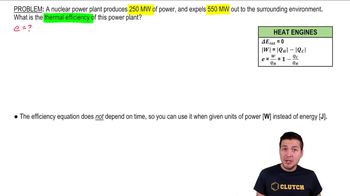
Efficiency of a Nuclear Power Plant

Plasma Physics

Plasma is a state of matter where gas is ionized, meaning it contains free electrons and ions. In fusion research, creating and maintaining a plasma at extremely high temperatures (like 1.0 x 10⁸ K) is essential for overcoming the electrostatic repulsion between positively charged nuclei. Plasma physics involves understanding the behavior of charged particles in electromagnetic fields, which is critical for confining plasma using magnetic fields in fusion reactors.
Recommended video:
Guided course
03:18
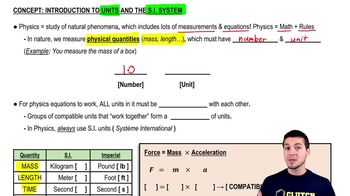
Introduction to Units & the SI System

Cyclotron Motion

Cyclotron motion refers to the circular motion of charged particles in a magnetic field, where the radius of the orbit depends on the particle's speed and the strength of the magnetic field. In the context of fusion, maintaining deuterium ions in cyclotron orbits allows for effective confinement of the plasma. The relationship between the magnetic field strength and the radius of the orbit is essential for calculating the required field strength to keep the fastest ions within a specified diameter, ensuring they remain in the desired confinement area.
Recommended video:
Related Practice
Textbook Question

It is shown in more advanced courses that charged particles in circular orbits radiate electromagnetic waves, called cyclotron radiation. As a result, a particle undergoing cyclotron motion with speed v is actually losing kinetic energy at the ratedKdt=(μ0q46πcm2)B2v2\(\frac{dK}{dt}\) = - \(\left\)( \(\frac{\mu_0 q^4}{6\pi c m^2}\) \(\right\)) B^2 v^2

How long does it take (a) an electron and (b) a proton to radiate away half its energy while spiraling in a 2.0 T magnetic field?

217
views
Textbook Question

FIGURE P29.64 shows a mass spectrometer, an analytical instrument used to identify the various molecules in a sample by measuring their charge-to-mass ratio q/m. The sample is ionized, the positive ions are accelerated (starting from rest) through a potential difference ∆V, and they then enter a region of uniform magnetic field. The field bends the ions into circular trajectories, but after just half a circle they either strike the wall or pass through a small opening to a detector. As the accelerating voltage is slowly increased, different ions reach the detector and are measured. Consider a mass spectrometer with a 200.00 mT magnetic field and an 8.0000 cm spacing between the entrance and exit holes. To five significant figures, what accelerating potential differences ∆V are required to detect the ions (a) O₂⁺ (b) N₂⁺ and (c) CO⁺? See Exercise 29 for atomic masses; the mass of the missing electron is less than 0.001 u and is not relevant at this level of precision. Although N₂⁺ and CO⁺ both have a nominal molecular mass of 28, they are easily distinguished by virtue of their slightly different accelerating voltages. Use the following constants: 1 u = 1.6605 x 10⁻²⁷ kg, e = 1.6022 x 10⁻¹⁹ C.

1575
views
Textbook Question

The uniform 30 mT magnetic field in FIGURE P29.65 points in the positive z-direction. An electron enters the region of magnetic field with a speed of 5.0 x 10⁶ m/s and at an angle of 30° above the xy-plane. Find the radius r and the pitch p of the electron's spiral trajectory.

294
views
Textbook Question

Particle accelerators, such as the Large Hadron Collider, use magnetic fields to steer charged particles around a ring. Consider a proton ring with 36 identical bending magnets connected by straight segments. The protons move along a 1.0-m-long circular arc as they pass through each magnet. What magnetic field strength is needed in each magnet to steer protons around the ring with a speed of 2.5 x 10⁷ m/s? Assume that the field is uniform inside the magnet, zero outside.

263
views
Textbook Question

A proton moves in the uniform fields E = 2500 k V/m and B = 0.50 k T. At t = 0 s the proton is moving in a 1.0-cm-diameter circle in the xy-plane. How many revolutions will the proton have made during this time interval?

242
views
Textbook Question

In FIGURE P29.75, a long, straight, current-carrying wire of linear mass density μ is suspended by threads. A magnetic field perpendicular to the wire exerts a horizontal force that deflects the wire to an equilibrium angle θ. Find an expression for the strength and direction of the magnetic field B.

495
views