
Ch 33: Wave Optics
Knight Calc - Physics for Scientists and Engineers 5th Edition
Knight Calc5th EditionPhysics for Scientists and EngineersISBN: 9780137344796Not the one you use?Change textbook
Chapter 33, Problem 68

A Michelson interferometer operating at a 600 nm wavelength has a 2.00-cm-long glass cell in one arm. To begin, the air is pumped out of the cell and mirror M₂ is adjusted to produce a bright spot at the center of the interference pattern. Then a valve is opened and air is slowly admitted into the cell. The index of refraction of air at 1.00 atm pressure is 1.00028. How many bright-dark-bright fringe shifts are observed as the cell fills with air?

Verified step by step guidance
1
Step 1: Understand the problem. A Michelson interferometer creates interference patterns based on the difference in optical path length between its two arms. When air fills the glass cell, the refractive index changes, altering the optical path length and causing fringe shifts. The goal is to calculate the number of fringe shifts observed.
Step 2: Recall the formula for optical path length. The optical path length (OPL) is given by the product of the refractive index (n) and the physical length of the medium (L). For the glass cell, the OPL changes from n = 1 (vacuum) to n = 1.00028 (air). The change in OPL is ΔOPL = (n_air - n_vacuum) × L.
Step 3: Relate the change in optical path length to fringe shifts. Each fringe shift corresponds to a change in optical path length equal to one wavelength (λ). The number of fringe shifts (N) is given by N = ΔOPL / λ. Substitute ΔOPL = (n_air - n_vacuum) × L and λ = 600 nm into this formula.
Step 4: Convert units as needed. Ensure all quantities are in consistent units. For example, convert the wavelength λ from nanometers to centimeters (1 nm = 10⁻⁷ cm) to match the length of the glass cell, which is given in centimeters.
Step 5: Perform the calculation. Substitute the values: n_air = 1.00028, n_vacuum = 1, L = 2.00 cm, and λ = 600 nm (converted to cm). Calculate ΔOPL and then divide by λ to find the number of fringe shifts. This will give the total number of bright-dark-bright fringe shifts observed.

Verified video answer for a similar problem:

This video solution was recommended by our tutors as helpful for the problem above.
Was this helpful?

Key Concepts

Here are the essential concepts you must grasp in order to answer the question correctly.

Interference Patterns

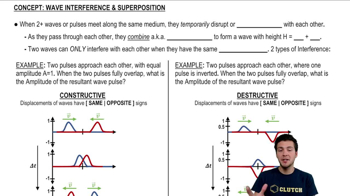
Interference patterns arise from the superposition of light waves, leading to regions of constructive and destructive interference. In a Michelson interferometer, light beams split and travel different paths before recombining, creating a pattern of bright and dark fringes. The number of fringes observed is influenced by changes in the optical path length, which can be altered by factors such as the medium through which the light travels.
Recommended video:
Guided course
03:47
Wave Interference & Superposition

Index of Refraction

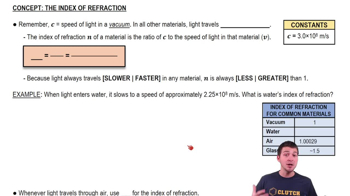
The index of refraction (n) is a dimensionless number that describes how light propagates through a medium. It is defined as the ratio of the speed of light in a vacuum to the speed of light in the medium. In this scenario, the index of refraction of air at 1.00 atm pressure is given as 1.00028, indicating that light travels slightly slower in air than in a vacuum, which affects the optical path length and consequently the interference pattern.
Recommended video:
Guided course
03:46
Index of Refraction

Fringe Shift Calculation

Fringe shift refers to the movement of the interference pattern due to changes in the optical path length. Each full fringe shift corresponds to a change in optical path length of one wavelength of light. In this problem, as air is introduced into the glass cell, the change in the index of refraction alters the effective wavelength of light in the medium, allowing for the calculation of the number of fringe shifts based on the change in optical path length caused by the filling of the cell.
Recommended video:
Guided course
09:05
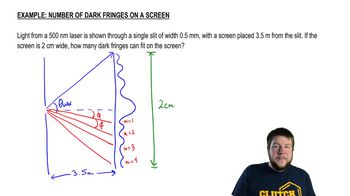
Number of Dark Fringes on a Screen
Related Practice
Textbook Question

Light of wavelength 600 nm passes though two slits separated by 0.20 mm and is observed on a screen 1.0 m behind the slits. The location of the central maximum is marked on the screen and labeled y = 0. A very thin piece of glass is then placed in one slit. Because light travels slower in glass than in air, the wave passing through the glass is delayed by 5.0×10⁻¹⁶ s in comparison to the wave going through the other slit. What fraction of the period of the light wave is this delay?

112
views
Textbook Question

Light of wavelength 600 nm passes though two slits separated by 0.20 mm and is observed on a screen 1.0 m behind the slits. The location of the central maximum is marked on the screen and labeled y = 0. With the glass in place, what is the phase difference Δϕ0 between the two waves as they leave the slits?

112
views
Textbook Question

A radar for tracking aircraft broadcasts a 12 GHz microwave beam from a 2.0-m-diameter circular radar antenna. From a wave perspective, the antenna is a circular aperture through which the microwaves diffract. If the antenna emits 100 kW of power, what is the average microwave intensity at 30 km?

54
views
Textbook Question

FIGURE CP33.74 shows light of wavelength λ incident at angle ϕ on a reflection grating of spacing d. We want to find the angles θm at which constructive interference occurs. Light of wavelength 500 nm is incident at ϕ=40° on a reflection grating having 700 reflection lines/mm. Find all angles θm at which light is diffracted. Negative values of θm are interpreted as an angle left of the vertical.

99
views
Textbook Question

A double-slit experiment is set up using a helium-neon laser (λ = 633 nm). Then a very thin piece of glass (n = 1.50) is placed over one of the slits. Afterward, the central point on the screen is occupied by what had been the m = 10 dark fringe. How thick is the glass?

1958
views
Textbook Question

FIGURE CP33.73 shows two nearly overlapped intensity peaks of the sort you might produce with a diffraction grating (see Figure 33.9b). As a practical matter, two peaks can just barely be resolved if their spacing Δy equals the width w of each peak, where w is measured at half of the peak’s height. Two peaks closer together than w will merge into a single peak. We can use this idea to understand the resolution of a diffraction grating. In the small-angle approximation, the position of the m = 1 peak of a diffraction grating falls at the same location as the m = 1 fringe of a double slit: y1 = λL/d. Suppose two wavelengths differing by Δλ pass through a grating at the same time. Find an expression for Δy, the separation of their first-order peaks.

1454
views