
Ch 11: Impulse and Momentum
Knight Calc - Physics for Scientists and Engineers 5th Edition
Knight Calc5th EditionPhysics for Scientists and EngineersISBN: 9780137344796Not the one you use?Change textbook
Chapter 11, Problem 24b

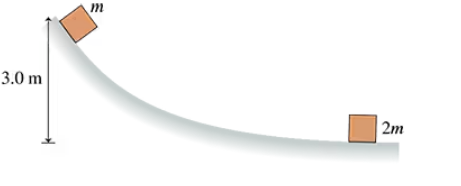
A package of mass m is released from rest at a warehouse loading dock and slides down the 3.0-m-high, frictionless chute of FIGURE EX11.24 to a waiting truck. Unfortunately, the truck driver went on a break without having removed the previous package, of mass 2m, from the bottom of the chute. Suppose the collision between the packages is perfectly elastic. To what height does the package of mass m rebound?

Verified step by step guidance
1
Step 1: Calculate the velocity of the package of mass m at the bottom of the chute using the principle of conservation of energy. The potential energy at the top is converted into kinetic energy at the bottom. Use the formula: \( v = \sqrt{2gh} \), where \( g \) is the acceleration due to gravity and \( h \) is the height of the chute.
Step 2: Analyze the collision between the two packages. Since the collision is perfectly elastic, both momentum and kinetic energy are conserved. Write the equations for conservation of momentum: \( m v + 2m \cdot 0 = m v_1 + 2m v_2 \), and conservation of kinetic energy: \( \frac{1}{2} m v^2 = \frac{1}{2} m v_1^2 + \frac{1}{2} (2m) v_2^2 \).
Step 3: Solve the system of equations from Step 2 to find the velocities \( v_1 \) (velocity of mass m after collision) and \( v_2 \) (velocity of mass 2m after collision).
Step 4: Determine the rebound height of the package of mass m using its velocity \( v_1 \) after the collision. Use the conservation of energy principle again, where the kinetic energy at the bottom is converted back into potential energy at the rebound height. The formula is \( h_{rebound} = \frac{v_1^2}{2g} \).
Step 5: Substitute the values obtained into the equations to express the rebound height \( h_{rebound} \) in terms of the given quantities \( m \), \( g \), and \( h \).

Verified video answer for a similar problem:

This video solution was recommended by our tutors as helpful for the problem above.
Was this helpful?

Key Concepts

Here are the essential concepts you must grasp in order to answer the question correctly.

Conservation of Energy

The principle of conservation of energy states that in a closed system, the total energy remains constant. In this scenario, the potential energy of the package of mass m at the top of the chute is converted into kinetic energy as it slides down. The initial potential energy can be calculated using the formula PE = mgh, where h is the height, and this energy will determine the speed of the package just before the collision.
Recommended video:
Guided course
06:24
Conservation Of Mechanical Energy

Elastic Collision

An elastic collision is one in which both momentum and kinetic energy are conserved. In this problem, when the package of mass m collides with the stationary package of mass 2m, the conservation laws will allow us to calculate the final velocities of both packages after the collision. This is crucial for determining how high the lighter package rebounds after the impact.
Recommended video:
Guided course
08:56
Intro To Elastic Collisions

Kinematics of Motion

Kinematics involves the study of motion without considering the forces that cause it. After the collision, the rebound height of the package of mass m can be determined using kinematic equations. Specifically, we can use the relationship between the final velocity after the collision and the maximum height reached, applying the formula v^2 = 2gh, where v is the velocity just after the collision and h is the height.
Recommended video:
Guided course
08:25
Kinematics Equations
Related Practice