Ch 02: Kinematics in One Dimension
Knight Calc - Physics for Scientists and Engineers 5th Edition
Knight Calc5th EditionPhysics for Scientists and EngineersISBN: 9780137344796Not the one you use?Change textbook
Chapter 2, Problem 30b

A snowboarder glides down a 50-m-long, 15° hill. She then glides horizontally for 10 m before reaching a 25° upward slope. Assume the snow is frictionless. How far can she travel up the 25° slope?

Verified step by step guidance
1
Identify the key principles: This problem involves energy conservation. Since the snow is frictionless, mechanical energy is conserved. The snowboarder's initial potential energy is converted into kinetic energy as she descends the hill, and then that kinetic energy is partially converted back into potential energy as she ascends the 25-degree slope.
Calculate the snowboarder's speed at the bottom of the 15-degree hill: Use the conservation of energy principle. The initial potential energy at the top of the hill is \( U = m g h \), where \( h \) is the vertical height of the hill. The vertical height can be found using \( h = L \sin(\theta) \), where \( L = 50 \ \text{m} \) and \( \theta = 15^\circ \). The kinetic energy at the bottom is \( K = \frac{1}{2} m v^2 \). Set \( U = K \) to solve for \( v \).
Determine the snowboarder's speed after gliding horizontally: Since the horizontal section is frictionless, no energy is lost, and the snowboarder maintains the same speed \( v \) as at the bottom of the hill.
Set up the energy conservation equation for the 25-degree slope: As the snowboarder travels up the slope, her kinetic energy is converted back into potential energy. The potential energy at the highest point on the slope is \( U = m g h \), where \( h \) is the vertical height she reaches. The vertical height can be related to the distance traveled \( d \) along the slope using \( h = d \sin(\theta) \), where \( \theta = 25^\circ \). Use the equation \( \frac{1}{2} m v^2 = m g h \) to solve for \( d \).
Simplify and solve for \( d \): Cancel out the mass \( m \) from the equation, substitute \( h = d \sin(\theta) \), and rearrange to find \( d \). The final expression will depend on the initial speed \( v \) calculated earlier and the angle \( \theta \).

Verified video answer for a similar problem:

This video solution was recommended by our tutors as helpful for the problem above.
Video duration:
16m
Was this helpful?

Key Concepts

Here are the essential concepts you must grasp in order to answer the question correctly.

Conservation of Energy

The principle of conservation of energy states that in a closed system, the total energy remains constant. In this scenario, the snowboarder converts gravitational potential energy into kinetic energy as she descends the hill. When she reaches the upward slope, her kinetic energy will be converted back into potential energy, allowing us to calculate how far she can travel up the slope.
Recommended video:
Guided course
06:24
Conservation Of Mechanical Energy

Gravitational Potential Energy

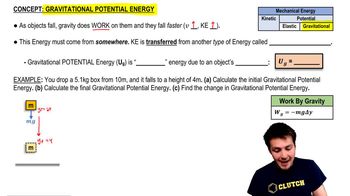
Gravitational potential energy (PE) is the energy an object possesses due to its position in a gravitational field, calculated as PE = mgh, where m is mass, g is the acceleration due to gravity, and h is the height. As the snowboarder moves up the slope, her kinetic energy decreases while her potential energy increases, which is crucial for determining the maximum height she can reach on the slope.
Recommended video:
Guided course
06:35
Gravitational Potential Energy

Kinematics of Inclined Planes

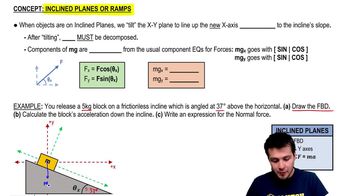
Kinematics of inclined planes involves analyzing the motion of objects on slopes, taking into account angles and distances. In this problem, the snowboarder's motion on the 25-degree slope can be analyzed using trigonometric relationships to determine the vertical height she can achieve based on her initial kinetic energy, which is influenced by her descent from the hill.
Recommended video:
Guided course
06:59
Intro to Inclined Planes