Ch 39: Wave Functions and Uncertainty
Knight Calc - Physics for Scientists and Engineers 5th Edition
Knight Calc5th EditionPhysics for Scientists and EngineersISBN: 9780137344796Not the one you use?Change textbook
Chapter 39, Problem 25

What is the minimum uncertainty in position, in nm, of an electron whose velocity is known to be between 3×10⁵ m/s and 4 ×10⁵ m/s? Give your answer to one significant figure.

Verified step by step guidance
1
Start by identifying the uncertainty in velocity (Δv). Since the velocity is known to be between 3×10⁵ m/s and 4×10⁵ m/s, the uncertainty in velocity is Δv = 4×10⁵ m/s - 3×10⁵ m/s = 1×10⁵ m/s.
Use Heisenberg's Uncertainty Principle, which states Δx * Δp ≥ ℏ / 2, where Δx is the uncertainty in position, Δp is the uncertainty in momentum, and ℏ is the reduced Planck's constant (ℏ ≈ 1.055×10⁻³⁴ J·s).
Express the uncertainty in momentum (Δp) in terms of the uncertainty in velocity (Δv) using the relationship Δp = m * Δv, where m is the mass of the electron (m ≈ 9.11×10⁻³¹ kg).
Substitute Δp = m * Δv into the uncertainty principle equation to find Δx: Δx ≥ ℏ / (2 * m * Δv).
Plug in the known values (ℏ = 1.055×10⁻³⁴ J·s, m = 9.11×10⁻³¹ kg, and Δv = 1×10⁵ m/s) into the equation Δx ≥ ℏ / (2 * m * Δv) to calculate the minimum uncertainty in position, and convert the result to nanometers (1 nm = 1×10⁻⁹ m).

Verified video answer for a similar problem:

This video solution was recommended by our tutors as helpful for the problem above.
Was this helpful?

Key Concepts

Here are the essential concepts you must grasp in order to answer the question correctly.

Heisenberg's Uncertainty Principle

Heisenberg's Uncertainty Principle states that it is impossible to simultaneously know both the exact position and exact momentum of a particle. This principle implies that the more accurately we know a particle's velocity (momentum), the less accurately we can know its position. This relationship is fundamental in quantum mechanics and highlights the inherent limitations in measuring quantum systems.
Recommended video:
Guided course
14:47
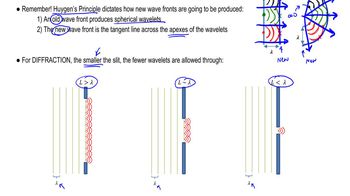
Diffraction with Huygen's Principle

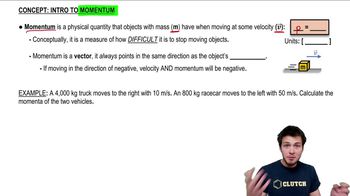
Momentum

Momentum is defined as the product of an object's mass and its velocity. In the context of quantum mechanics, momentum is a crucial variable that relates to the uncertainty in position. For an electron, knowing its velocity allows us to calculate its momentum, which is essential for applying the uncertainty principle to determine the minimum uncertainty in its position.
Recommended video:
Guided course
05:17
Intro to Momentum

Calculating Uncertainty

To calculate the uncertainty in position, we can use the formula derived from Heisenberg's principle: Δx * Δp ≥ ħ/2, where Δx is the uncertainty in position, Δp is the uncertainty in momentum, and ħ is the reduced Planck's constant. By determining the range of velocities, we can find the uncertainty in momentum and subsequently calculate the minimum uncertainty in position for the electron.
Recommended video:
Guided course
04:15
Calculating Dot Product Using Vector Components