Ch 32: AC Circuits
Knight Calc - Physics for Scientists and Engineers 5th Edition
Knight Calc5th EditionPhysics for Scientists and EngineersISBN: 9780137344796Not the one you use?Change textbook
Chapter 32, Problem 42b

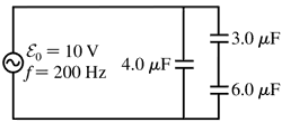
What is the peak voltage across the 3.0 μF capacitor?

Verified step by step guidance
1
Step 1: Identify the components in the circuit. The circuit consists of an AC voltage source with a peak voltage of 10 V and a frequency of 200 Hz, connected to three capacitors: 4.0 μF, 3.0 μF, and 6.0 μF. The 3.0 μF and 6.0 μF capacitors are in parallel, and this combination is in series with the 4.0 μF capacitor.
Step 2: Calculate the equivalent capacitance of the parallel combination of the 3.0 μF and 6.0 μF capacitors. For capacitors in parallel, the equivalent capacitance is given by: Ceq=C1+C2. Substituting the values: Ceq=3.0+6.0=9.0μF.
Step 3: Calculate the total equivalent capacitance of the circuit. The 9.0 μF equivalent capacitance from Step 2 is in series with the 4.0 μF capacitor. For capacitors in series, the equivalent capacitance is given by: Ceq=11C1+1C2. Substituting the values: Ceq=114.0+19.0.
Step 4: Determine the voltage across the 9.0 μF equivalent capacitance (which includes the 3.0 μF capacitor). The voltage across capacitors in series is divided inversely proportional to their capacitances. Use the formula: V1=Vtotal×CeqC1. Substituting the values for the total voltage (10 V) and the capacitances, calculate the voltage across the 9.0 μF equivalent capacitance.
Step 5: Calculate the voltage across the 3.0 μF capacitor. Since the 3.0 μF and 6.0 μF capacitors are in parallel, they share the same voltage. The voltage across the 3.0 μF capacitor is equal to the voltage across the 9.0 μF equivalent capacitance calculated in Step 4.

Verified video answer for a similar problem:

This video solution was recommended by our tutors as helpful for the problem above.
Was this helpful?

Key Concepts

Here are the essential concepts you must grasp in order to answer the question correctly.

Capacitance

Capacitance is the ability of a capacitor to store charge per unit voltage. It is measured in farads (F), with common subunits like microfarads (μF). In this circuit, the capacitors have values of 3.0 μF, 4.0 μF, and 6.0 μF, which determine how much charge they can hold when connected to a voltage source.
Recommended video:
Guided course
08:02
Capacitors & Capacitance (Intro)

AC Voltage and Peak Voltage

In alternating current (AC) circuits, voltage varies sinusoidally over time. The peak voltage (E₀) is the maximum voltage reached in one cycle, which in this case is given as 10 V. Understanding peak voltage is crucial for analyzing how capacitors behave in AC circuits, as it influences the charge stored in the capacitors.
Recommended video:
Guided course
07:14
RMS Current and Voltage

Series and Parallel Capacitors

Capacitors can be arranged in series or parallel configurations, affecting the total capacitance of the circuit. In this case, the 3.0 μF and 6.0 μF capacitors are in parallel with the 4.0 μF capacitor. The total capacitance for parallel capacitors is the sum of their capacitances, which is essential for calculating the voltage across each capacitor.
Recommended video:
Guided course
09:51
Combining Capacitors in Series & Parallel