Ch 25: The Electric Potential
Knight Calc - Physics for Scientists and Engineers 5th Edition
Knight Calc5th EditionPhysics for Scientists and EngineersISBN: 9780137344796Not the one you use?Change textbook
Chapter 25, Problem 29b

In a semiclassical model of the hydrogen atom, the electron orbits the proton at a distance of 0.053 nm. What is the electron's potential energy?

Verified step by step guidance
1
Step 1: Recall the formula for the potential energy of a system of two charges. The potential energy (U) is given by the equation: U=-kqq1q2r, where k is Coulomb's constant, qq1 and q2 are the charges of the proton and electron, and r is the distance between them.
Step 2: Identify the values of the constants and variables. The charge of the electron and proton is q=1.6×10¹⁹ C and q=1.6×10¹⁹ C, respectively. Coulomb's constant is k=8.99×10⁹ N·m²/C². The distance r is given as 0.053 nm, which needs to be converted to meters: 0.053×10⁹ m.
Step 3: Substitute the known values into the formula. Replace k, q1, q2, and r into the equation: U=-8.99×109×(1.6×1019)×(1.6×1019)0.053×10⁹.
Step 4: Simplify the numerator. Multiply the constants and charges in the numerator: (8.99×109)×(1.6×1019)×(1.6×1019). This will yield a negative value because the charges are opposite in sign.
Step 5: Divide the result of the numerator by the denominator. Use the value of r in meters to complete the calculation. The final result will give the potential energy in joules (J).

Verified video answer for a similar problem:

This video solution was recommended by our tutors as helpful for the problem above.
Video duration:
5m
Was this helpful?

Key Concepts

Here are the essential concepts you must grasp in order to answer the question correctly.

Coulomb's Law

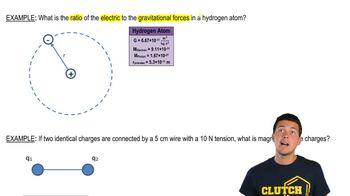
Coulomb's Law describes the electrostatic force between two charged particles. In the case of the hydrogen atom, it explains the attractive force between the negatively charged electron and the positively charged proton. The potential energy associated with this force can be calculated using the formula U = -k * (e^2 / r), where k is Coulomb's constant, e is the charge of the electron, and r is the distance between the charges.
Recommended video:
Guided course
09:52
Coulomb's Law

Potential Energy in Electric Fields

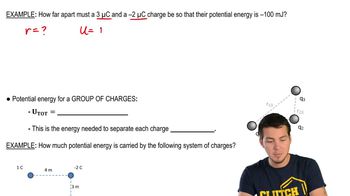
In the context of electric fields, potential energy represents the work done to move a charge from a reference point to a specific point in the field. For the hydrogen atom, the potential energy of the electron is negative, indicating that work must be done against the electric force to separate the electron from the proton. This negative value reflects the stability of the electron's orbit around the proton.
Recommended video:
Guided course
07:51
Electric Potential Energy

Quantum Mechanics and Energy Levels

Quantum mechanics introduces the concept of quantized energy levels for electrons in atoms. While the semiclassical model approximates the electron's orbit, it is important to recognize that in reality, electrons exist in probabilistic clouds rather than fixed orbits. The potential energy calculated in this model is a simplification, but it provides insight into the energy interactions within the atom, which are foundational for understanding atomic structure.
Recommended video:
Guided course
06:24
Conservation Of Mechanical Energy