
Ch 03: Vectors and Coordinate Systems
Knight Calc - Physics for Scientists and Engineers 5th Edition
Knight Calc5th EditionPhysics for Scientists and EngineersISBN: 9780137344796Not the one you use?Change textbook
Chapter 3, Problem 45

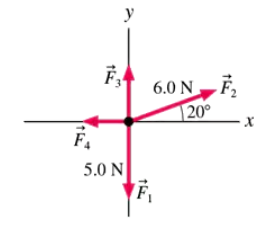
Four forces are exerted on the object shown in FIGURE P3.45P3.45. (Forces are measured in newtons, abbreviated N\text{N}.) The net force on the object is Fnet=F1+F2+F3+F4=4.0i^N\vec{F}_{\text{net}}=\vec{F}_1+\vec{F}_2+\vec{F}_3+\vec{F}_4=4.0\,\hat{\mathbf{i}}\,\text{N}. What are (a) F3\vec{F}_3 and (b) F4\vec{F}_4? Give your answers in component form.

Verified step by step guidance
1
Step 1: Break down the forces into their components. For Fₐ (7.0 N upward along the y-axis), the x-component is 0 and the y-component is 7.0 N. For Fᵦ (unknown magnitude along the positive x-axis), the x-component is Fᵦ and the y-component is 0. For F𝒸 (unknown magnitude downward along the negative y-axis), the x-component is 0 and the y-component is -F𝒸. For F𝒹 (5.0 N at 30° below the negative x-axis), calculate its components using trigonometry: x-component = -5.0 cos(30°), y-component = -5.0 sin(30°).
Step 2: Write the equation for the net force in the x-direction. The net force in the x-direction is given as 4.0 N. Using the components: Fₙₑₜₓ = Fᵦ + (-5.0 cos(30°)). Solve for Fᵦ.
Step 3: Write the equation for the net force in the y-direction. The net force in the y-direction is 0 N (since the object is not accelerating vertically). Using the components: Fₙₑₜᵧ = 7.0 + (-F𝒸) + (-5.0 sin(30°). Solve for F𝒸.
Step 4: Combine the results to find F₃ and F₄. F₃ corresponds to Fᵦ, which is purely in the x-direction, and F₄ corresponds to F𝒸, which is purely in the y-direction. Express both forces in component form.
Step 5: Verify the solution by ensuring the calculated components satisfy the given net force conditions (Fₙₑₜₓ = 4.0 N and Fₙₑₜᵧ = 0 N).

Verified video answer for a similar problem:

This video solution was recommended by our tutors as helpful for the problem above.
Video duration:
8m
Was this helpful?

Key Concepts

Here are the essential concepts you must grasp in order to answer the question correctly.

Net Force

The net force is the vector sum of all individual forces acting on an object. It determines the object's acceleration according to Newton's second law, F_net = ma. In this problem, the net force is given as 4.0 N in the positive x-direction, which means the combined effect of all forces must result in this specific vector.
Recommended video:
Guided course
06:28
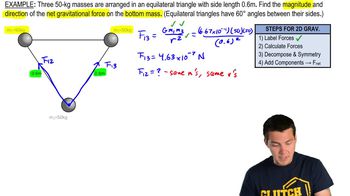
Finding Net Forces in 2D Gravitation

Vector Components

Forces can be broken down into their components along the x and y axes. This is essential for analyzing forces in two dimensions. Each force can be expressed as F_x and F_y, allowing for easier calculations of the net force by summing the respective components. In this case, we need to find the components of forces F₃ and F₄.
Recommended video:
Guided course
07:30
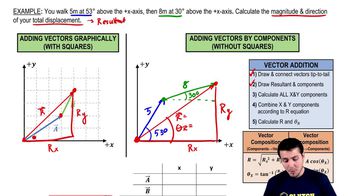
Vector Addition By Components

Trigonometric Functions in Force Analysis

Trigonometric functions, such as sine and cosine, are used to resolve forces into their components when angles are involved. For example, if a force is applied at an angle, its x and y components can be calculated using F_x = F * cos(θ) and F_y = F * sin(θ). This is particularly relevant for force F_d, which is at a 30° angle, requiring the use of trigonometry to find its contributions to the net force.
Recommended video:
Guided course
05:00
Dimensional Analysis
Related Practice
Textbook Question

The bacterium E. coli is a single-cell organism that lives in the gut of healthy animals, including humans. When grown in a uniform medium in the laboratory, these bacteria swim along zig-zag paths at a constant speed of 20 μm/s. FIGURE P3.42 shows the trajectory of an E. coli as it moves from point A to point E. What are the magnitude and direction of the bacterium's average velocity for the entire trip?

2209
views
Textbook Question

FIGURE P3.43 shows three ropes tied together in a knot. One of your friends pulls on a rope with 3.0 units of force and another pulls on a second rope with 5.0 units of force. How hard and in what direction must you pull on the third rope to keep the knot from moving? Give the direction as an angle below the negative x-axis.

2001
views
Textbook Question

A crate, seen from above, is pulled with three ropes that have the tensions shown in FIGURE P3.44. Tension is a vector directed along the rope, measured in newtons (abbreviated N). Suppose the three ropes are replaced with a single rope that has exactly the same effect on the crate. What is the tension in this rope? Write your answer in component form using unit vectors.

1318
views
Textbook Question

FIGURE P3.46 shows four electric charges located at the corners of a rectangle. Like charges, you will recall, repel each other while opposite charges attract. Charge B exerts a repulsive force (directly away from B) on charge A of 3.0 N. Charge C exerts an attractive force (directly toward C) on charge A of 6.0 N. Finally, charge D exerts an attractive force of 2.0 N on charge A. Assuming that forces are vectors, what are the magnitude and direction of the net force Fnet exerted on charge A?

669
views