
Ch 20: The Micro/Macro Connection
Knight Calc - Physics for Scientists and Engineers 5th Edition
Knight Calc5th EditionPhysics for Scientists and EngineersISBN: 9780137344796Not the one you use?Change textbook
Chapter 20, Problem 75

A 2.0 mol sample of oxygen gas in a rigid, 15 L container is slowly cooled from 250℃ to 50℃ by being in thermal contact with a large bath of 50℃ water. What is the entropy change of (a) the gas and (b) the universe?

Verified step by step guidance
1
Step 1: Understand the problem and identify the key concepts. The problem involves calculating the entropy change of the gas and the universe during a cooling process. Entropy change is related to heat transfer and temperature, and the gas is treated as an ideal gas. The formula for entropy change for an ideal gas is ΔS = nC_v ln(T_f/T_i), where n is the number of moles, C_v is the molar heat capacity at constant volume, T_f is the final temperature, and T_i is the initial temperature.
Step 2: Convert the temperatures from Celsius to Kelvin. Since entropy calculations require absolute temperature, add 273.15 to each temperature. T_i = 250 + 273.15 = 523.15 K and T_f = 50 + 273.15 = 323.15 K.
Step 3: Determine the molar heat capacity at constant volume (C_v) for oxygen gas. For diatomic gases like oxygen, C_v = (5/2)R, where R is the universal gas constant (R = 8.314 J/(mol·K)). Substitute this value into the formula for entropy change.
Step 4: Calculate the entropy change of the gas using the formula ΔS_gas = nC_v ln(T_f/T_i). Substitute n = 2.0 mol, C_v = (5/2)R, T_f = 323.15 K, and T_i = 523.15 K into the equation. Simplify the logarithmic term ln(T_f/T_i) and multiply by the constants.
Step 5: To find the entropy change of the universe, note that the gas is in thermal contact with a large bath at 50℃ (323.15 K). The heat lost by the gas is gained by the bath, and the entropy change of the bath is ΔS_bath = -Q/T_bath, where Q is the heat transferred and T_bath is the temperature of the bath. Use the first law of thermodynamics to relate Q to the change in internal energy of the gas, and calculate ΔS_universe = ΔS_gas + ΔS_bath.

Verified video answer for a similar problem:

This video solution was recommended by our tutors as helpful for the problem above.
Video duration:
12m
Was this helpful?

Key Concepts

Here are the essential concepts you must grasp in order to answer the question correctly.

Entropy

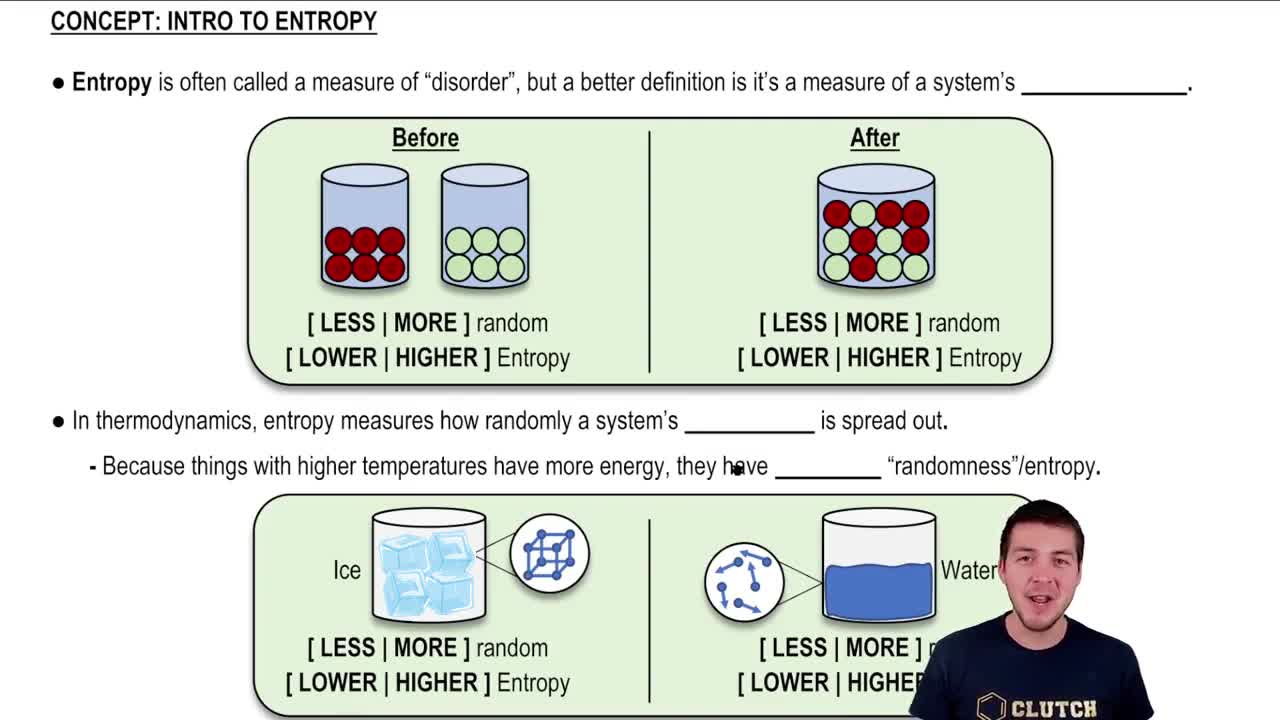
Entropy is a measure of the disorder or randomness in a system. In thermodynamics, it quantifies the amount of energy in a physical system that is not available to do work. When a system undergoes a change, such as cooling, the change in entropy can indicate whether the process is spontaneous or requires energy input. For gases, entropy increases with temperature and volume, and decreases when the gas is cooled.
Recommended video:
Guided course
07:50
Intro to Entropy

Thermodynamic Processes

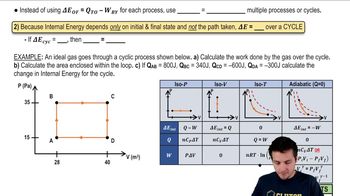
Thermodynamic processes describe the changes in state of a system due to heat transfer and work done. In this scenario, the oxygen gas is undergoing a cooling process while remaining in a rigid container, meaning its volume does not change. The heat exchange with the water bath at a constant temperature influences the entropy change of both the gas and the universe, as energy is transferred from the gas to the water.
Recommended video:
Guided course
08:45
Properties of Cyclic Thermodynamic Processes

The Second Law of Thermodynamics

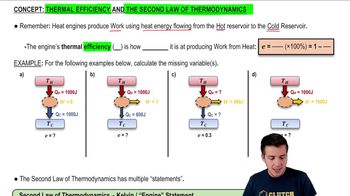
The Second Law of Thermodynamics states that the total entropy of an isolated system can never decrease over time. It implies that natural processes tend to move towards a state of maximum disorder or equilibrium. In this question, calculating the entropy change of the gas and the universe involves understanding how energy disperses and how the cooling of the gas affects the overall entropy, including the water bath and surroundings.
Recommended video:
Guided course
06:01
Thermal Efficiency & The Second Law of Thermodynamics