Back
Back Blitzer 3rd EditionCh. 2 - Graphs of the Trigonometric Functions; Inverse Trigonometric Functions
Problem 66
In Exercises 61–66, use the method of adding y-coordinates to graph each function for 0 ≤ x ≤ 2π. y = cos x + sin 2x
Problem 68
In Exercises 67–68, use the method of adding y-coordinates to graph each function for 0 ≤ x ≤ 4. y = cos πx + sin π/2 x
Problem 75
In Exercises 75–78, graph one period of each function. y = |2 cos x/2|
Problem 77
In Exercises 75–78, graph one period of each function. y = −|3 sin πx|
Problem 80
In Exercises 79–82, graph f, g, and h in the same rectangular coordinate system for 0 ≤ x ≤ 2π. Obtain the graph of h by adding or subtracting the corresponding y-coordinates on the graphs of f and g. f(x) = 2 cos x, g(x) = cos 2x, h(x) = (f + g)(x)
Problem 82
In Exercises 79–82, graph f, g, and h in the same rectangular coordinate system for 0 ≤ x ≤ 2π. Obtain the graph of h by adding or subtracting the corresponding y-coordinates on the graphs of f and g. f(x) = cos x, g(x) = sin 2x, h(x) = (f − g)(x)
Problem 1
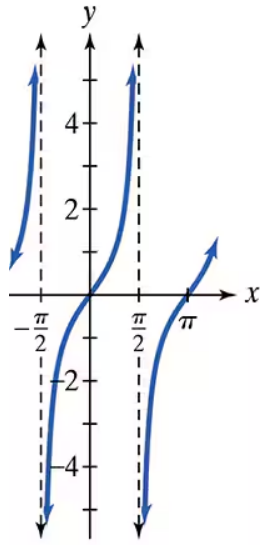
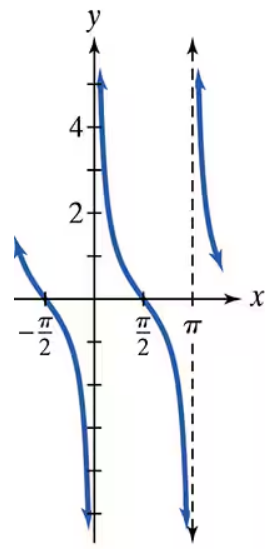
The graph of a tangent function is given. Select the equation for each graph from the following options: y = tan(x + π/2), y = tan(x + π), y= -tan x, y = −tan(x − π/2).
Problem 3
The graph of a tangent function is given. Select the equation for each graph from the following options: y = tan(x + π/2), y = tan(x + π), y = -tan x, y = −tan(x − π/2).
Problem 5
Graph two periods of the given tangent function. y = 3 tan x/4
Problem 9
Graph two periods of the given tangent function. y = −2 tan (1/2) x
Problem 12
Graph two periods of the given tangent function. y = tan(x − π/4)
Problem 13
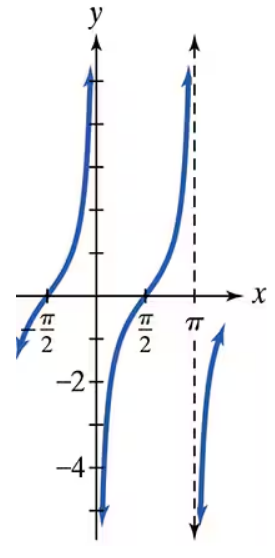
The graph of a cotangent function is given. Select the equation for each graph from the following options: y = cot(x + π/2), y = cot(x + π), y = −cot x, y= −cot(x − π/2).
Problem 17
In Exercises 17–24, graph two periods of the given cotangent function. y = 2 cot x
Problem 19
In Exercises 17–24, graph two periods of the given cotangent function. y = 1/2 cot 2x
Problem 21
In Exercises 17–24, graph two periods of the given cotangent function. y = −3 cot π/2 x
Problem 23
In Exercises 17–24, graph two periods of the given cotangent function. y = 3 cot(x + π/2)
Problem 25
In Exercises 25–28, use each graph to obtain the graph of the corresponding reciprocal function, cosecant or secant. Give the equation of the function for the graph that you obtain.
Problem 26
Use each graph to obtain the graph of the corresponding reciprocal function, cosecant or secant. Give the equation of the function for the graph that you obtain.
<IMAGE>
Problem 27
In Exercises 25–28, use each graph to obtain the graph of the corresponding reciprocal function, cosecant or secant. Give the equation of the function for the graph that you obtain.
Problem 28
Use each graph to obtain the graph of the corresponding reciprocal function, cosecant or secant. Give the equation of the function for the graph that you obtain.
<IMAGE>
Problem 29
In Exercises 29–44, graph two periods of the given cosecant or secant function. y = 3 csc x
Problem 30
Graph two periods of the given cosecant or secant function.
y = 2 csc x
Problem 31
In Exercises 29–44, graph two periods of the given cosecant or secant function. y = 1/2 csc x/2
Problem 33
In Exercises 29–44, graph two periods of the given cosecant or secant function. y = 2 sec x
Problem 34
Graph two periods of the given cosecant or secant function.
y = 3 sec x
Problem 35
In Exercises 29–44, graph two periods of the given cosecant or secant function. y = sec x/3
Problem 36
Graph two periods of the given cosecant or secant function.
y = sec x/2
Problem 37
In Exercises 29–44, graph two periods of the given cosecant or secant function. y = −2 csc πx
Problem 39
In Exercises 29–44, graph two periods of the given cosecant or secant function. y = −1/2 sec πx
Problem 41
In Exercises 29–44, graph two periods of the given cosecant or secant function. y = csc(x − π)