In Exercises 27–38, use a calculator to find the value of each expression rounded to two decimal places.___tan⁻¹ (−√473)
Verified step by step guidance
1
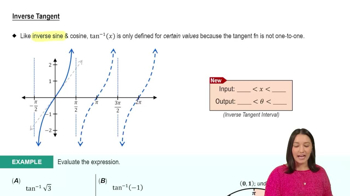
Identify the function: The problem involves the inverse tangent function, denoted as \( \tan^{-1} \). This function is used to find the angle whose tangent is the given value.
Understand the input: The input to the inverse tangent function is \(-\sqrt{473}\). This is a negative number, which means the angle will be in the fourth quadrant of the unit circle.
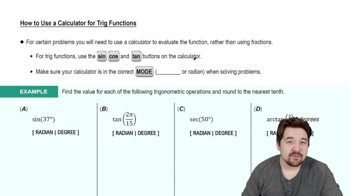
Use a calculator: Input \(-\sqrt{473}\) into the calculator's inverse tangent function. Ensure your calculator is set to the correct mode (degrees or radians) as required by your context.
Interpret the result: The calculator will provide an angle. If the calculator is in degree mode, the result will be in degrees. If in radian mode, the result will be in radians.
Round the result: Once you have the angle, round it to two decimal places as instructed in the problem.
Verified video answer for a similar problem:
This video solution was recommended by our tutors as helpful for the problem above
Video duration:
1m
Play a video:
Was this helpful?
Key Concepts
Here are the essential concepts you must grasp in order to answer the question correctly.
Inverse Trigonometric Functions
Inverse trigonometric functions, such as tan⁻¹, are used to find the angle whose tangent is a given number. For example, tan⁻¹(x) returns the angle θ such that tan(θ) = x. These functions are essential for solving problems where the angle is unknown, and they have specific ranges to ensure unique outputs.
Using a calculator to evaluate trigonometric functions requires understanding how to input values correctly. Most scientific calculators have dedicated buttons for inverse functions, allowing users to compute angles directly. Familiarity with the calculator's settings, such as degree or radian mode, is crucial for obtaining accurate results.
Rounding numbers is a mathematical process used to simplify a number while retaining its approximate value. In this context, rounding to two decimal places means adjusting the result of the calculation to the nearest hundredth. This is important for presenting answers clearly and concisely, especially in practical applications.