Textbook Question
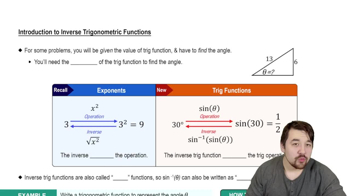
In Exercises 29–51, find the exact value of each expression. Do not use a calculator. tan [cos⁻¹ (− 4/5)]
786
views

 Blitzer 3rd EditionCh. 2 - Graphs of the Trigonometric Functions; Inverse Trigonometric FunctionsProblem 45
 Verified step by step guidance
 4:28
4:28
 5:35
5:35 6:25
6:25In Exercises 29–51, find the exact value of each expression. Do not use a calculator. tan [cos⁻¹ (− 4/5)]
In Exercises 43–52, determine the amplitude, period, and phase shift of each function. Then graph one period of the function. y = 3 cos(2x − π)
In Exercises 39–54, find the exact value of each expression, if possible. Do not use a calculator. tan (tan⁻¹ 125)
Determine the amplitude, period, and phase shift of each function. Then graph one period of the function.
y = cos(x + π/2)
In Exercises 43–52, determine the amplitude, period, and phase shift of each function. Then graph one period of the function. y = 1/2 cos (3x + π/2)
Determine the amplitude, period, and phase shift of each function. Then graph one period of the function.
y = 4 cos(2x − π)