
Students blog

Explore the latest trends, tips, and experiences in college life in this blog written by fellow students.

Explore posts in other areas.

PreK-12Higher EducationProfessional

  • A computer generated image of a female student in front of a bookcase.

    Study Zones: Improve Focus by Connecting Spaces to Subjects

    Andrea Ramirez

    Ever sit down to study and realize you’re spending more time trying to focus than actually learning? You’re not alone. I used to start study sessions with the best intentions, only to find myself distracted or doom-scrolling within minutes.

    Over time, I discovered a surprisingly effective strategy for improving focus: linking specific subjects to specific places. Simply returning to the same physical location to work on the same subject helped me “get in the zone” faster.

    Assign Your Study Zones

    Pick a different place for each major subject. These spaces don’t have to be fancy or far apart. A corner of your room, a table in the library, or even a favorite café can work.

    For example, I made the science building’s quiet corner my go-to spot for Calculus. I always chose the same section of the library for Chemistry. Physics? That became my Starbucks subject.

    Over time, something clicked. Just walking into one of those spaces would cue my brain into the right mindset, and I’d dive straight into the work.

    I first came across this idea during my sophomore year at Miami Dade College, before transferring to FIU. At the time, I was juggling Organic Chemistry, Physics, Calculus II, and a part-time job. My brain felt scattered, and switching between subjects drained more energy than the assignments themselves.

    That’s when I started experimenting with what I now call “study zones,” assigning each subject its own home base. Over time, it improved both my focus while studying and my retention of the material.

    How Your Brain Links Location to Learning

    The more often you return to the same spot for the same subject, the stronger the connection becomes. This is thanks to the hippocampus, a part of the brain responsible for memory and navigation. It helps us create what neuroscientists call a cognitive map. It’s how we remember not just where we are, but also what we experienced in those places.

    Spatial memory and learning are tightly linked, meaning environments can reinforce what we study (Weiler, 2024). When we consistently review one subject in the same location, our brains strengthen that association. This makes the information easier to recall later.

    Study Blocks and Mini-Goals

    I’ve found this method is most effective when I avoid long study marathons. Instead, I use shorter blocks of time.

    One of the best uses of my study zones has been during my breaks between classes. I go straight to that subject's study spot and use the time to debrief. These shorter study sessions feel focused and productive without leaving me drained.

    It’s also important to set small goals when you arrive at each zone. Before you start studying, tell yourself, “I’ll review two chapters while I’m here.” Clear, realistic goals help you maintain momentum while studying.

    Get creative and think about how you can connect the spaces around you to your course subjects. By building this association, you help cue your brain to focus and make it easier to recall information. Creating study zones won’t give you instant laser focus, but it will remind you why you’re there: to study, not to scroll.

    Reference

    Weiler, Nicolas. “Space and Memory.” From Our Neurons to Yours, Wu Tsai Neurosciences Institute Stanford University, 22 Feb. 2024. https://neuroscience.stanford.edu/news/space-and-memory.

    Do you have a compelling story or student success tips you’d like to see published on the Pearson Students blog?  If you are a college student and interested in writing for us – click here to pitch your idea and get started! 
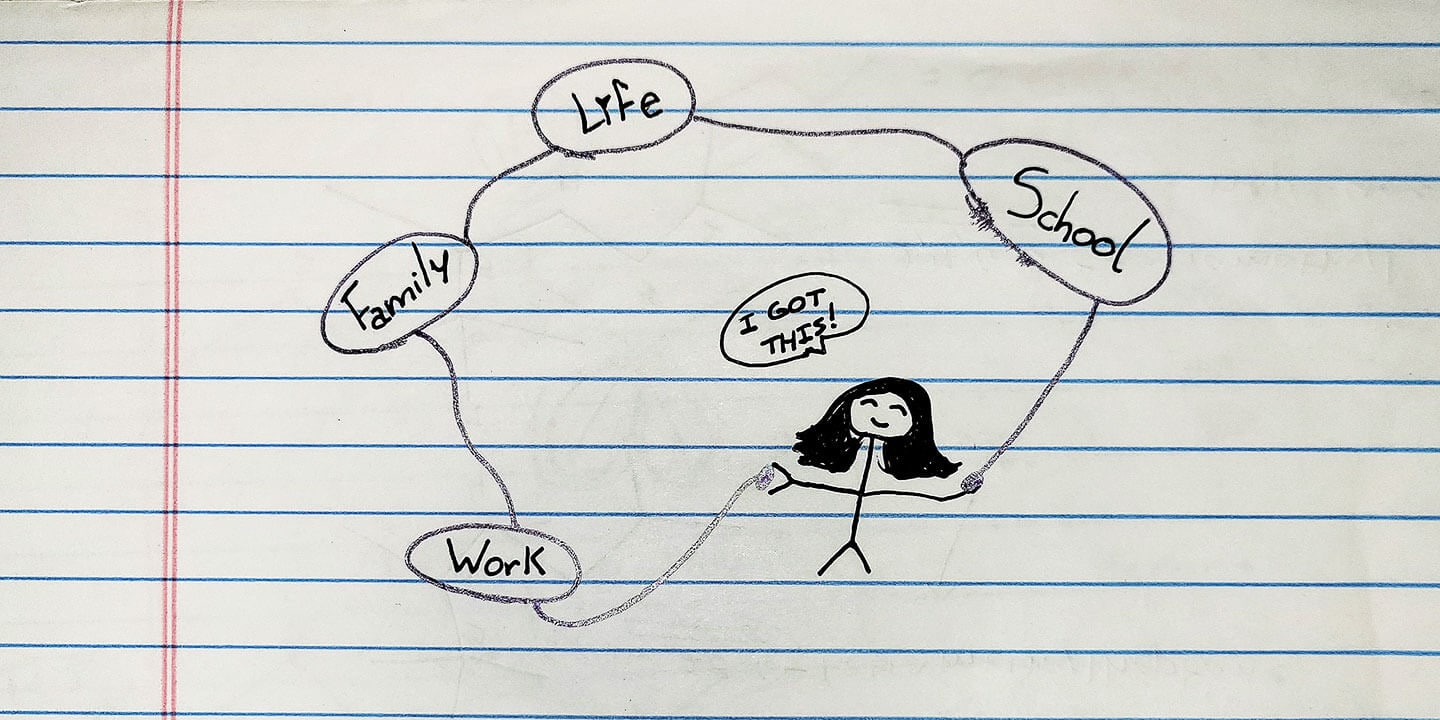
     

  • A hand-drawn doodle on lined notebook paper with a stick figure holding a string connecting the words School, Life, Family, Work and a dialogue bubble that says, ‘I GOT THIS!’

    Balancing Work and School: Lessons from My Journey

    Andrea Ramirez

    In high school, everyone talks about how challenging college academics can be, but no one really prepares us for the transition into adulthood that comes with it. I grew up in Venezuela until I was 15, when my family decided to move to the U.S. It was a drastic change, new country, new life, new education system and I had to adapt quickly to keep up. I researched everything about college life, academics, and tips for success, but nothing could fully prepare me for the reality. Because life isn’t just about academics; it also includes family, friends, work, and personal growth. At this age, we’re transitioning from young adults to fully independent adults, and learning to balance everything is key. 

    I got my first job as a freshman in college. Even though I was a multitasker in high school—playing volleyball and cross-country college was an entirely new level. My first semester went great; I finished with a 4.0 GPA and made the Dean’s List. Then, spring semester hit, and it wasn’t as easy. I failed my first class ever. I was shocked. I had never failed a class before. But instead of letting it get to me; I took it as a lesson. I reflected on what worked for me in the Fall semester and what I did differently in the Spring semester that led to my struggles. By the Summer semester, I had figured out a balance that allowed me to succeed academically while keeping up with work and personal life. Now, as I near graduation, I want to share the lessons I learned along the way and things I wish I had known when I first started: 

    1. Make a Schedule That Works for You 


    Everyone is different, and what works for your friends may not work for you. At first, I tried to go to class in the morning and work immediately afterward. But by the time I got home at night, I was too exhausted to study or even eat properly, for the next day to do the same and my academics suffered. I realized that I needed to change my approach. I rearranged my schedule so that I focused on school from Monday to Wednesday and worked from Wednesday afternoon to Friday. This way, I still had weekends off and could dedicate my first three days of the week solely to schoolwork. Find what works best for you and adjust accordingly. 

    2. Make a Priority List 


    What matters most to you? Family? School? Work? Once you identify your priorities, it becomes easier to create a schedule that allows you to enjoy those things. If spending time with family is important, then structure your week so that you can dedicate a day to them. Knowing your priorities helps you avoid burning out and ensures that you’re investing your time wisely. 

    3. It’s Okay to Say No 


    This was a hard lesson for me. My family was struggling financially, so I always took extra shifts at work. Before I knew it, I was covering for everyone, but my grades were slipping, and I was neglecting my health. I was just surviving, not living. Eventually, I realized I needed boundaries. It’s okay to say no to extra work, to a hangout, or to anything that drains you beyond your ability. 

    Protect yourself. 


    4. Speak Up for Yourself 


    There are doors that won’t open unless you push them yourself. Stay on top of your academic progress—regularly check in with your professors, meet with your counselor, and advocate for yourself. If you need help, ask for it. No one will fight for your success more than you. The dream is yours. 

    5. Use Tools That Will Help You Succeed 


    We live in time where technology is everywhere, take advantage. Many students have already gone through your major or university, and there are online resources that can save you time. For me, Pearson+ was a game changer, it allowed me to upload my syllabus, and it created a personalized study plan for me. Tools like YouTube tutorials, study apps, and tutoring can also be incredibly helpful. Use whatever resources you need to succeed. 
 

    I hope these tips help you navigate the balancing act of college and work. It’s not easy, but with the right approach, you can thrive in both areas. Remember, you’re not just getting a degree, you’re also learning how to manage life as an adult. Make the most of it and enjoy the process.

    Do you have a compelling story or student success tips you’d like to see published on the Pearson Students blog?  If you are a college student and interested in writing for us – click here to pitch your idea and get started!