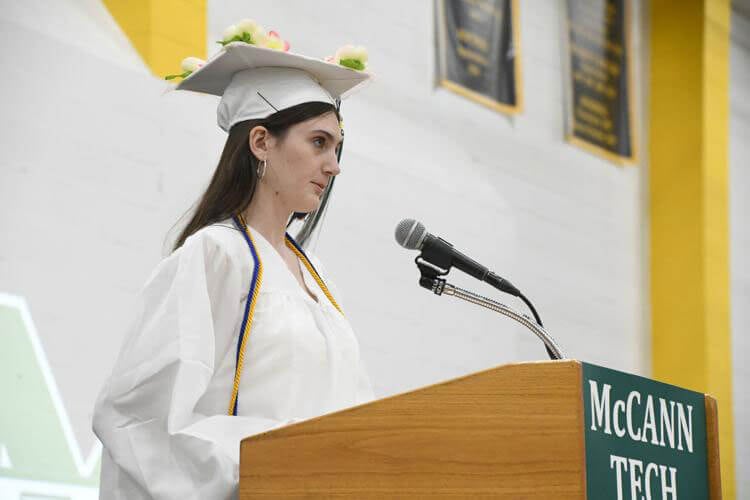
Students don’t need to wait until graduation to start their careers
For many high school students, figuring out what comes after graduation can feel overwhelming. But when they have opportunities to explore careers, build in-demand skills, earn recognized credentials, and connect classroom learning to the real world, their path forward can become much clearer.
For Ryleigh Holland of Stamford, Vermont, that path led to architecture.
As a student at McCann Technical High School, Ryleigh wasn't always sure what she wanted her future career to look like. Attending a school focused on career and technical education gave her the opportunity to explore different possibilities, and ultimately discover a passion that would shape her future.
Discovering a passion for architecture
A major turning point came when Ryleigh enrolled in a computer-aided design (CAD) program taught by Mr. King.
Through his guidance and encouragement, Ryleigh began exploring architecture and developing technical skills using professional design software. Mr. King also introduced her to Autodesk Certified User certifications, showing how industry-recognized credentials could strengthen her education and future career opportunities.
During her junior year, Ryleigh earned certifications in Autodesk AutoCAD and Autodesk Revit. Her credentials not only showed what she learned in the classroom, they also gave her a chance to apply her skills on the job.

Turning classroom skills into workplace experience
Ryleigh's certifications helped her secure a co-op position with Hesnor Engineering Associates, where she has already worked as a CAD Technician for more than a year.
"Having my certifications helped me get my co-op job," Ryleigh said. “Getting certified showed my team that I already had knowledge and expertise, and that meant that I got to work on higher-level projects very early on."
Because she was focused on building job-ready skills as a student, Ryleigh didn’t have to wait until after graduation to begin building her career. She was mastering technology, proving what she knew, and applying that knowledge in a professional environment while still in high school.
Creating opportunities beyond the workplace
Those same experiences also strengthened Ryleigh's path to higher education. When applying to Syracuse University's architecture program, she was able to demonstrate more than an interest in the field. She had a portfolio of work (including a project rendered with Revit), professional experience, industry certifications, and practical skills developed through years of hands-on learning.
Her accomplishments have also earned recognition beyond the classroom. She won gold at her district Massachusetts SkillsUSA competition and received the Massachusetts Outstanding Vocational Student Award.
But for Ryleigh, the biggest accomplishment has been finding work she genuinely enjoys. "I feel like I've found work I'm passionate about and had amazing opportunities I wouldn't have otherwise," she said.

Putting career-ready skills to the test
One of those opportunities came through the North Adams Accessory Dwelling Unit (ADU) competition. Ryleigh used both AutoCAD and Revit to transform her ideas into a fully developed design, and was selected as one of three student winners.
And she's only getting started. "This is just the beginning for me," Ryleigh said. "I can't wait to continue using my skills in the world of architecture, both at Syracuse and beyond."
Help students build their own path to career readiness
Every student's career journey will look different. Giving students opportunities to explore careers, develop in-demand skills, earn meaningful credentials, and connect learning to real-world experiences can help turn their interests into possibilities.
Explore Pearson Career Ready resources and discover how you can help students, like Ryleigh, build the skills, confidence, and credentials they need for what comes next.